Why Isn't Braille the Same in Every Language?
Braille uses a shared tactile framework around the world, but the rules that give its patterns meaning can vary by language, country, and subject. Here's why.
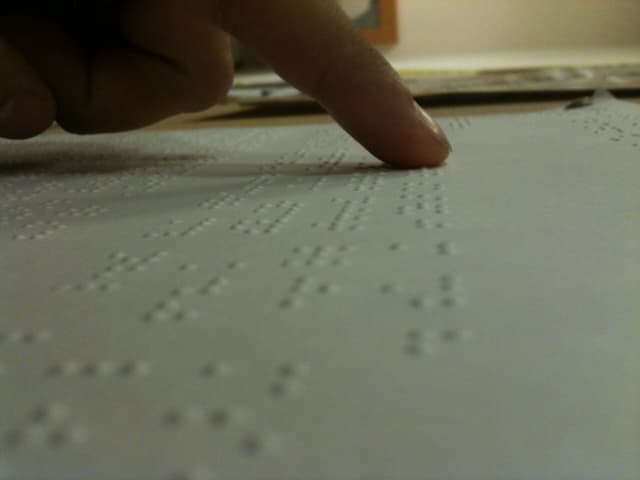
There Isn't Just One Braille
If you have ever seen a Braille alphabet, it is easy to come away with a simple idea: each letter has a pattern of raised dots, and those patterns make up a universal alphabet that can be used everywhere.
That picture is useful, but it is incomplete. Braille is better understood as a family of codes built on a common tactile system. The physical building block is remarkably consistent: a small cell of raised dots. What those dots mean, and how they are combined, can depend on the language, the country, the purpose of the text, and the rules being used.
The Library of Congress notes that there are more than 100 distinct Braille codes worldwide. English, Arabic, Japanese, Indian languages, mathematics, music, and computer notation can all require different rules while using the same basic tactile idea.
So the interesting question is not why every language invented a completely different Braille alphabet. It is how so many different writing systems can share the same tiny collection of tactile patterns.
The Dots Are the Easy Part
A standard six-dot Braille cell has two columns and three rows. Each dot has a position, and every possible combination of those positions produces a different pattern.
Six positions give 64 possible combinations, including the completely blank cell. That leaves 63 nonblank patterns. It sounds like a tiny alphabet, especially when ordinary writing has far more than a few dozen symbols once you include letters, numbers, punctuation, and other signs.
But Braille does not need one permanent pattern for every possible thing a reader might encounter. A pattern can acquire meaning from the code being used and from the surrounding text. Additional conventions allow a relatively small set of physical patterns to represent much more than 63 concepts.
This is one reason Unicode treats Braille differently from an ordinary character alphabet. Unicode can encode the physical Braille patterns, but it does not decide that one particular pattern must represent the same letter in every language.
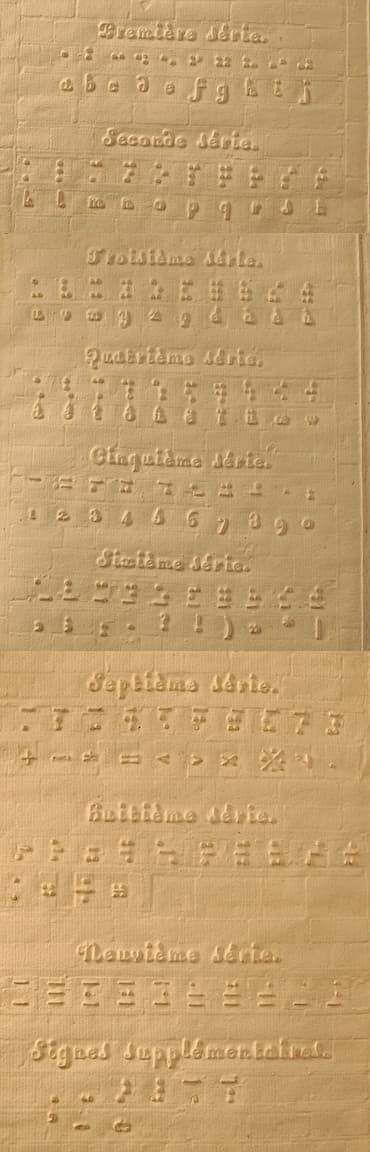
A Pattern Doesn't Come With a Meaning
Think of a Braille cell as a small piece of notation rather than a printed letter carved into six positions. The dots describe a shape. A Braille code supplies the rules that tell you how to interpret that shape.
This distinction matters because different writing systems have different requirements. A code for an alphabetic language has to represent letters and punctuation. A code for another writing system may need to represent syllables or combinations of sounds. A literary code may use contractions to save space. A mathematics code needs symbols and relationships that ordinary prose does not.
Unicode's Braille specification makes this separation explicit. The standard represents the possible dot patterns, including the six-dot and eight-dot forms, without assigning a universal linguistic meaning to every pattern. The assignment of patterns to characters or other units is determined by the relevant Braille code.
In other words, the dots are the common hardware. The code is the software.
So What Actually Makes a Braille Code?
A Braille code is much more than a table matching letters to dot patterns. It can contain rules for capitalization, numbers, punctuation, contractions, abbreviations, indicators, and the way different signs interact with one another.
That is why two pieces of Braille can look similar at first glance while requiring different interpretation. A sign can function differently depending on the code and the context around it.
Contracted Braille is a good example. Instead of spelling every English word one letter at a time, a code can assign a pattern or sequence to a common group of letters, a frequently occurring word, or another recurring unit. This reduces the amount of space needed and can make reading and writing more efficient.
The result is closer to a writing system with grammar-like conventions than to a simple substitution cipher. You cannot always translate Braille correctly by looking up each cell independently.
Why Languages Need Their Own Braille Rules
The simplest case is a language that uses a different writing system. The Latin alphabet, Arabic script, Devanagari, and Japanese writing do not organize information in exactly the same way, so a tactile code cannot simply copy an English letter table and call the problem solved.
Languages also differ in spelling, punctuation, abbreviations, grammatical conventions, and the kinds of symbols readers need. A Braille system therefore has to decide how the structures of a particular language will fit into the available tactile patterns.
This does not mean every language gets an unrelated collection of dots. Many systems deliberately reuse patterns and conventions from established Braille traditions. The shared cell provides a common physical foundation while the language-specific code provides the interpretation.
That is why saying that Braille is one universal alphabet is misleading. A better description is that Braille provides a highly reusable tactile framework on which different codes can be built.
The Same Framework Can Support Different Languages
English is a useful starting point because modern English Braille has its own well-developed rules, including Unified English Braille. But the same six-dot framework can also be adapted to languages that use scripts very different from English.
Indian languages provide a particularly interesting example. Bharati Braille was developed as a common framework for Indian languages, allowing languages using different print scripts to be represented through Braille while retaining language-specific rules.
The current Bharati Braille 2.1 standard, published by India's National Institute for the Empowerment of Persons with Visual Disabilities in 2026, covers 13 Indian languages across nine scripts. It includes rules for characters, vowels, vowel signs, consonants, punctuation, digits, conjunct characters, and forward translation.
The important idea is not that all of those languages suddenly became identical. They did not. The point is that a shared tactile framework can accommodate their differences when the code defines how each language is represented.
Even English Couldn't Agree on One Code
The story gets even more interesting when you look at English-speaking countries. The challenge was not simply that different languages needed different Braille systems. English itself had competing systems and conventions.
During the nineteenth and twentieth centuries, different tactile writing systems competed for adoption, including Braille and New York Point. Even after Braille became widely established, British and American English Braille developed differences in areas such as contractions and technical notation.
This became part of what is sometimes called the War of the Dots: a long-running struggle over which tactile system and conventions should be used, particularly in the United States.
The debate shows that standardization is not automatic. A writing system can be technically effective and still face competition from systems that offer different advantages in space, writing, teaching, reading, or compatibility with existing materials.
The War of the Dots
The competing systems were not merely different ways of drawing the same alphabet. They reflected different ideas about what tactile reading should optimize.
Some raised-letter systems tried to preserve the appearance of ordinary printed letters. Others, including dot-based systems, were designed specifically for touch. Some systems saved more space than others. Some were easier for sighted teachers to recognize. Others were more convenient for a blind person to write.
New York Point became a serious competitor to Braille in the United States. Its patterns used horizontal arrangements of dots and could be compact, while Braille offered a more systematic cell-based structure and eventually gained broader support.
The eventual dominance of Braille was therefore not simply the result of someone proving that six dots were objectively perfect. It was the outcome of decades of experimentation, advocacy, education, publishing, and standardization.
How Unified English Braille Solved Part of the Problem
Modern English Braille has its own standardization story. Unified English Braille, usually called UEB, was created to bring greater consistency to English Braille across countries and to bring literary and many technical conventions into a more coherent system.
The International Council on English Braille approved UEB in 2004. It was subsequently adopted by English-speaking countries at different times, with the United States completing its transition in 2016.
UEB did not eliminate every specialized Braille code. Mathematics, music, and some other technical subjects can still require their own systems or code-switching rules. What UEB did was establish a common foundation for English literary Braille and a broad range of associated notation.
This is a useful pattern to remember: standardization does not necessarily mean creating one code for everything. It can mean agreeing on where one code applies and how it interacts with other specialized codes.
Braille Isn't Only for Letters
Once you stop thinking of Braille as a tactile alphabet, its flexibility becomes much easier to understand.
Braille can be used for ordinary prose, but tactile notation is also needed for mathematics, science, music, computing, and other specialized subjects. Those subjects contain relationships and symbols that cannot always be represented by simply assigning one Braille cell to one printed character.
Mathematical notation is a good example. A mathematical expression is not merely a sequence of letters. It can contain operators, fractions, superscripts, subscripts, grouping, and other structural relationships. Specialist Braille codes such as the Nemeth Code provide rules for representing this kind of material.
Music has its own Braille notation as well. Computer systems introduce another layer of complexity because software needs precise rules for converting between text, Braille displays, and specialized notation.
So Braille is not just a way to spell words with dots. It is a platform for tactile notation.
India's Braille Standard Is Still Evolving
Bharati Braille is a particularly useful modern example because it shows that Braille standardization is not something that ended in the nineteenth century.
India's National Institute for the Empowerment of Persons with Visual Disabilities released Bharati Braille 2.1 in July 2026. The updated standard is Unicode-mapped and provides refined translation rules for 13 Indian languages across nine scripts.
The process also involved consultation and technical validation. A draft was opened for public consultation in January 2026, and the work included testing and software-related implementation. The open-source Liblouis Braille translation project subsequently updated its Malayalam table to follow the new Bharati Braille rules.
That last detail is easy to overlook, but it reveals something important: a change to a Braille standard does not stay on paper. Translation software, digital accessibility tools, Braille displays, and other technology may all need to understand the new rules.
Computers Turned Braille Into a Translation Problem
A human reader who knows a Braille code can interpret tactile patterns using the rules they have learned. A computer has to be given those rules explicitly.
Modern Braille translation software therefore works with language-specific tables and translation rules. Liblouis, for example, supports many Braille systems and maintains tables for different languages, contracted and uncontracted Braille, computer Braille, and mathematical notation.
This is why a serious Braille translator cannot be thought of as a giant dictionary. It has to know which code it is using and how that code handles the input.
The direction of translation matters too. Converting ordinary text into Braille is one task; converting Braille back into readable text can require interpreting indicators, contractions, context, and the particular code from which the Braille came.
The six dots may be tiny, but the rule system sitting behind them can be surprisingly sophisticated.
What a Braille Translator Actually Has to Know
Imagine giving a translator the word 'read'. A basic character substitution system might process it one letter at a time. A real Braille system may need to consider whether the text is English, which English Braille code is being used, whether contractions are enabled, and whether any indicators are required.
Now replace English with an Indian language, or replace ordinary prose with mathematics. The rules change again.
That is the reason a Braille translator is more interesting than it first appears. It sits between two representations of language: ordinary text and a tactile notation system. The translator has to know the conventions that connect them.
Our Braille Translator uses uncontracted English Braille for straightforward text-to-Braille and Braille-to-text conversion. It is designed as a practical way to experiment with the underlying dot patterns, rather than pretending that one small lookup table represents every Braille code in existence.
So, Is There a Universal Braille Alphabet?
Not really.
There is a remarkably widespread physical idea: a small cell of raised dots that can be read by touch. Six-dot Braille provides a compact set of patterns, and the same basic framework has been adapted across languages and subjects for generations.
But the meaning of those patterns is determined by the code. Different languages can need different rules. English has its own standardized conventions. Indian languages can use Bharati Braille. Mathematics and music can require specialist notation. Computing introduces still more rules.
That is what makes Braille so interesting. Its universality does not come from every language agreeing to use exactly the same alphabet. It comes from many different systems being able to build on the same small tactile foundation.
The dots are shared. The code isn't.
Sources
- 1.About Braille
Library of Congress, National Library Service
- 2.Braille Codes
RNIB
- 3.Chapter 21: Halfwidth and Fullwidth Forms, Specials
Unicode Consortium
- 4.Unified English Braille
International Council on English Braille
- 5.Bharati Braille 2.1
National Institute for the Empowerment of Persons with Visual Disabilities
- 6.Public Consultation on Draft Bharati Braille 2.1
National Institute for the Empowerment of Persons with Visual Disabilities
- 7.Liblouis
Liblouis
- 8.War of the Dots
American Foundation for the Blind
- 9.Reading Braille
Eddau / Wikimedia Commons — CC0 1.0
- 10.Braille as first published in 1829
Louis Braille / Wikimedia Commons — Public domain