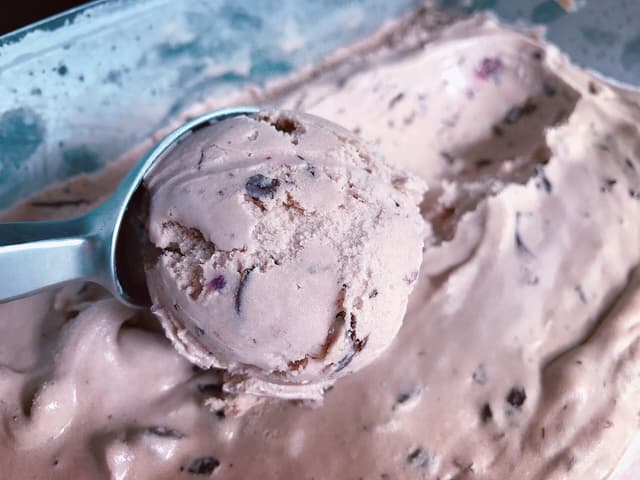
It was soft when it came out of the machine
Freshly churned homemade ice cream can look perfect. It folds into a bowl, holds a soft scoop and tastes smooth.
Leave the same batch in the freezer overnight and the spoon may barely make a dent.
A supermarket pint kept in that freezer may still be much easier to scoop.
The difference is not simply that commercial ice cream contains more fat, more sugar or more additives. Some expensive commercial ice creams contain relatively little air. Some homemade recipes are extremely rich. Either can still freeze hard if the balance is wrong.
The real question is how much of the water freezes, what remains between the ice crystals, how much air is trapped inside, and what structure is built around all of it.
Ice cream is never supposed to become one solid block of ice
Ice cream contains a lot of water, but good ice cream does not freeze all of that water into solid ice.
As the mixture cools, some water forms ice crystals. The ingredients dissolved in the remaining water become more concentrated. That concentrated liquid becomes progressively harder to freeze.
University of Guelph ice cream science material gives a useful example. At a typical serving temperature around minus 16°C, only about 72 percent of the original water in a conventional ice cream may be frozen. The rest remains in a concentrated liquid phase.
That unfrozen portion is crucial. If almost everything behaved like solid ice, a scoop of ice cream would behave much more like an ice cube.
Scoopability therefore depends partly on keeping the right amount of water unfrozen at freezer temperature.
Sugar changes how much water can freeze
Sugar does much more than make ice cream sweet.
Dissolving sugar in water lowers its freezing point. In an ice cream mix, that means some water remains unfrozen at temperatures where pure water would already be solid.
Use too little freezing point depression and more water freezes. The ice cream becomes harder. Push it too far and the ice cream can become excessively soft or difficult to freeze properly.
This is why simply reducing sugar in an ice cream recipe can have a much larger effect than reducing sweetness.
The Oliv ez Ice Cream Mix Calculator shows the percentage of added sucrose in a simple dairy mix. That is useful for checking the basic formulation, but sucrose percentage alone cannot predict scoopability because different sugars depress the freezing point by different amounts.
Not all sugars behave the same way
Two ice creams can contain the same percentage of sugar and still freeze differently.
Freezing point depression depends partly on the number of dissolved molecules. Smaller sugar molecules can have a stronger effect for the same weight than larger carbohydrate molecules.
Commercial formulations can therefore combine sucrose with ingredients such as dextrose, glucose syrups or other sweeteners to control sweetness, solids and freezing behavior separately.
University of Guelph's ice cream technology material describes this as a balancing act between sweetness, total solids and freezing point.
A home recipe based only on granulated sugar has fewer ways to adjust those properties independently.
Air changes the ice cream more than it seems
Ice cream is also a foam. Churning does not only freeze the mixture. It incorporates air.
The amount of air added is called overrun. If one litre of mix becomes 1.5 litres of ice cream, the increase in volume represents 50 percent overrun.
Air makes ice cream lighter and changes how it deforms under a spoon. Without incorporated air, frozen dairy mix would be much denser.
Commercial equipment can control overrun with far more consistency than most home machines. Some mass market products contain large amounts of air, while premium ice creams often use much less.
That means air can help explain why one ice cream is easier to scoop, but it is not a simple homemade versus commercial rule. Dense premium ice cream exists too.
Commercial freezing happens quickly
Ice crystal size matters almost as much as the amount of ice.
During commercial production, the mix is rapidly frozen while being scraped and whipped. University of Guelph describes continuous freezers that can move the mix through this stage in roughly 30 seconds, with about half of its water frozen when it leaves.
The partly frozen ice cream is then packaged and hardened at very low temperatures. Colorado State University's description of commercial processing places blast freezer hardening around minus 40°C.
Fast freezing produces many small ice crystals instead of giving a smaller number of crystals more time to grow.
A home ice cream maker has less refrigeration power, and a domestic freezer hardens the finished container more slowly. The result can still be excellent, but commercial equipment has a substantial advantage in controlling the freezing process.
Small crystals are what your tongue wants
Ice crystals do not need to be enormous before texture suffers.
The goal is to create many crystals that are small enough that the tongue does not perceive them as coarse pieces of ice.
The rate of freezing affects their initial size. What happens afterward matters too.
Whenever ice cream warms slightly, some of its ice melts. When it cools again, that water can refreeze onto existing crystals. Over repeated temperature changes, small crystals can become larger ones.
This process is called recrystallization. It is one reason a forgotten container of ice cream can become noticeably icier after weeks of opening, closing, warming and refreezing.
What stabilizers actually do
Stabilizers are often described as if they were antifreeze for ice cream. That is misleading.
Food gums such as guar gum and locust bean gum increase the viscosity of the unfrozen phase and help control the movement of water.
Research summarized by the Institute of Food Technologists reports that stabilizers have little or no effect on the initial freezing properties of an ice cream mix. Their important role appears later, when they slow the growth of ice crystals during recrystallization.
University of Guelph makes the same distinction. Without stabilizers, ice cream is more vulnerable to becoming coarse and icy as water migrates and crystals grow during storage.
A homemade batch eaten quickly may not need the same protection as a commercial carton expected to survive manufacturing, transport, supermarket freezers and weeks in a kitchen freezer.
Emulsifiers are doing a different job
Stabilizers and emulsifiers are often mentioned together, but they are not interchangeable.
Ice cream contains tiny fat droplets dispersed through water. During freezing and whipping, some of those fat droplets need to partially join together. That fat structure helps support the air bubbles inside the frozen product.
Emulsifiers encourage the right amount of this partial fat destabilization. The result affects smoothness, body, air stability and the way ice cream melts.
Egg yolk was one of the traditional ways to provide emulsifying compounds. Commercial ice cream may use ingredients such as mono and diglycerides or polysorbate 80.
These ingredients do not simply make ice cream softer. They help create the structure that makes frozen ice cream behave like ice cream rather than frozen sweetened milk.
Fat helps, but more fat is not an automatic fix
Fat reduces the proportion of water in the mix and contributes richness, lubrication and structure.
But increasing cream indefinitely is not a reliable way to make ice cream scoopable.
The fat has to work with the rest of the formulation. During freezing, part of the fat structure helps stabilize air cells. Too much or improperly structured fat can create other texture problems.
This is why commercial formulation looks at fat, milk solids, sweeteners and total solids together rather than treating cream as the single measure of quality.
Total solids decide how much room water gets
Imagine two mixes of the same weight. One contains much more water. The other replaces some of that water with milk solids, sugar, fat and other ingredients.
The first mix simply has more water available to become ice.
Milk proteins, lactose, sugars, fat and other solids all change the structure of the mix. Increasing solids can improve body and reduce the proportion of free water, although too many solids create their own problems.
This is one reason skim milk powder appears in many serious homemade ice cream recipes. It can increase milk solids without adding a large amount of extra fat.
Your Ice Cream Mix Calculator measures milk fat, milk solids not fat, added sucrose and total solids for this reason. Those numbers describe the starting mix, even though they cannot predict the entire freezing process by themselves.
Why the freezer exposes a weak formula
When ice cream first leaves the machine, much of its water is still unfrozen. It has the consistency of very thick soft serve.
Hardening continues in the freezer. More water turns to ice and the product becomes firmer.
A well balanced formulation reaches a useful compromise. Enough water freezes to give the ice cream structure, but enough remains unfrozen for the product to stay chewable and scoopable at its intended temperature.
A poorly balanced homemade mix can look excellent immediately after churning because it has not finished freezing yet. Several hours later, the freezer reveals how the formula actually behaves.
Store bought ice cream has been designed for the freezer
This is the largest difference between a casual home recipe and a commercial formulation.
A manufacturer can select several types of sweetener, control total solids, measure overrun, homogenize the fat, use stabilizers and emulsifiers, freeze rapidly, harden rapidly and test the finished product at specific storage and serving temperatures.
The aim is not simply to stop the ice cream from freezing hard. It is to control how much water freezes, how large the ice crystals become, how the air is distributed and how the structure survives storage.
A homemade recipe can reach the same general goal with simpler ingredients. It just has fewer tools and usually less powerful freezing equipment.
What actually makes ice cream easier to scoop
| Factor | What it changes |
|---|---|
| Sugar and sugar type | Controls sweetness and how much water remains unfrozen |
| Total solids | Reduces the proportion of water and changes body |
| Overrun | Adds air and changes density and mechanical texture |
| Freezing speed | Strongly affects initial ice crystal size |
| Stabilizers | Help limit ice crystal growth during storage |
| Emulsifiers | Help create fat structure and stabilize incorporated air |
| Storage temperature | Controls how much water is frozen at any moment |
No single row explains every scoopable pint. Good ice cream is the result of these factors working together.
The freezer is not turning your ice cream into something else
When homemade ice cream becomes rock hard overnight, the freezer is often exposing a formulation that looked softer only because it had not finished freezing.
Commercial ice cream has usually been designed around what happens after that point.
Its sugars determine how much water stays liquid. Its solids limit how much water is available. Air changes its density. Fat and emulsifiers build structure. Stabilizers help that structure survive storage. Rapid freezing keeps the ice crystals small.
That is why two containers sitting at the same freezer temperature can respond completely differently to the same spoon.