The math looks simple until it does not work
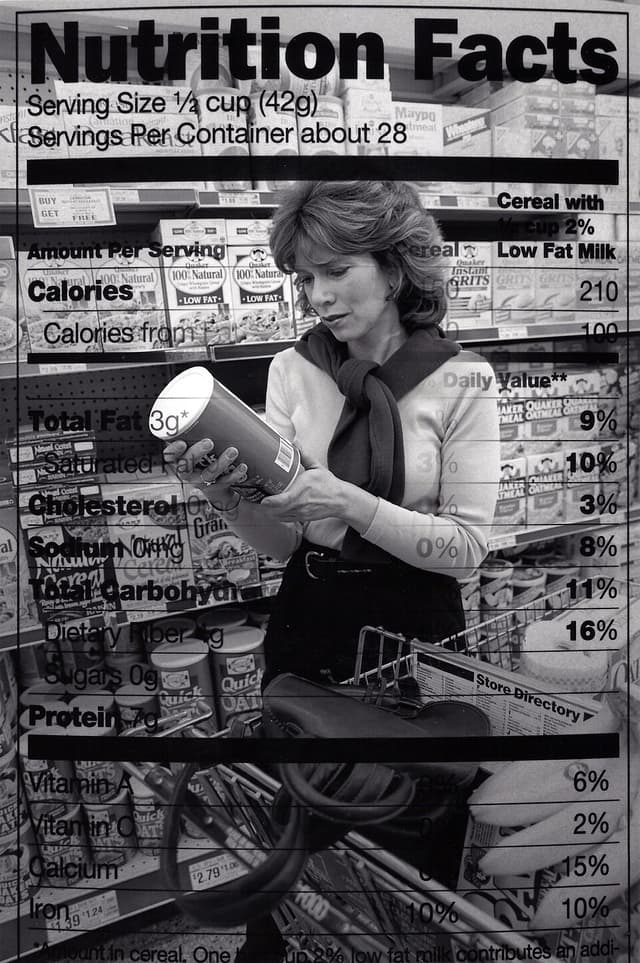
Take a Nutrition Facts label and do the usual calculation. Multiply grams of protein by 4, carbohydrate by 4 and fat by 9. Add the three numbers together.
Sometimes the answer matches the calorie number almost perfectly. Sometimes it does not.
That can look suspicious. If the package says 130 calories but the visible macros seem to produce something closer to 120, which number is wrong?
Often, neither is wrong.
The familiar 4 4 9 rule is useful, but it is not a rule that says every printed gram on a food label must reconstruct the printed calorie total exactly.
Where the 4 4 9 rule comes from
Protein and carbohydrate are commonly estimated at about 4 kilocalories per gram. Fat is commonly estimated at about 9. Alcohol, when present, contributes about 7 per gram.
These values come from the Atwater system, developed to estimate the amount of energy people can obtain from food rather than simply measuring how much heat the food releases when burned.
The numbers are averages. USDA still uses the general 4 4 9 factors for many calculations, but it also maintains more specific Atwater factors for individual foods and food groups.
| Component | Common general factor |
|---|---|
| Protein | 4 kcal per gram |
| Carbohydrate | 4 kcal per gram |
| Fat | 9 kcal per gram |
| Alcohol | About 7 kcal per gram |
The numbers you see have already been rounded
This is the easiest reason a label can refuse to add up.
A Nutrition Facts panel does not normally show the manufacturer's full precision. It shows rounded values that are easier to read.
Under current U.S. FDA rules, calories above 50 are generally declared in 10 calorie increments. Calories of 50 or less are generally shown in 5 calorie increments. Total fat, carbohydrate and protein have their own rounding rules.
The important detail is that FDA calorie calculations using food factors are based on the actual amounts before rounding. The manufacturer does not have to take the rounded grams printed on the package and multiply those numbers back together.
Imagine a food that actually contains 8.4 g of protein, 12.4 g of carbohydrate and 4.74 g of fat in a serving. Those underlying amounts produce about 126 calories with general 4 4 9 factors, which can appear as 130 calories after calorie rounding.
The label may show rounded macro values instead. If you take those visible numbers and perform your own calculation, you are calculating from a less precise set of numbers than the manufacturer used.
Several small rounding differences can therefore become one noticeable calorie difference.
A gram of carbohydrate does not always mean four calories
There is another problem with simply multiplying total carbohydrate by four. Total carbohydrate can contain components that do not provide four calories per gram.
Dietary fiber is the clearest example. Fiber appears within total carbohydrate on U.S. Nutrition Facts labels, but different forms of fiber can contribute less usable energy than ordinary digestible carbohydrate.
Current FDA rules provide a general value of 2 calories per gram for soluble non digestible carbohydrate in one permitted calorie calculation method. Insoluble non digestible carbohydrate can contribute zero under that method.
This means 20 grams of total carbohydrate is not necessarily the same thing as 20 grams of starch or sugar for calorie calculation.
Sugar alcohols make the shortcut even less reliable
Foods marketed as sugar free, reduced sugar or low carbohydrate often make the mismatch more obvious because they may contain sugar alcohols.
Sugar alcohols are carbohydrates, but the FDA does not assign all of them the standard 4 calories per gram.
| Sugar alcohol | FDA calorie factor |
|---|---|
| Erythritol | 0 kcal/g |
| Mannitol | 1.6 kcal/g |
| Isomalt | 2.0 kcal/g |
| Lactitol | 2.0 kcal/g |
| Maltitol | 2.1 kcal/g |
| Xylitol | 2.4 kcal/g |
| Sorbitol | 2.6 kcal/g |
| Hydrogenated starch hydrolysates | 3.0 kcal/g |
So if several grams of carbohydrate on the label come from erythritol, multiplying every gram of total carbohydrate by four can greatly overestimate the calories attributed to those carbohydrates.
Even some sugars do not fit the simple rule
Allulose is an unusual example.
It is included in total carbohydrate on U.S. labels, but the FDA allows manufacturers to use a caloric value of 0.4 calories per gram for allulose rather than the 4 calories per gram associated with traditional sugars.
Ten grams of allulose therefore does not contribute 40 calories simply because those grams sit inside the carbohydrate total.
This is another reason the carbohydrate number on the package cannot always be treated as one uniform substance.
USDA does not always use exactly 4 4 9 either
The 4 4 9 system itself is a simplified version of the Atwater approach.
USDA FoodData Central reports both general and, where available, food specific Atwater calculations. The specific factors account for differences in how energy is available from different foods.
USDA Handbook 74, for example, gives milk products factors of about 4.27 calories per gram for protein, 8.79 for fat and 3.87 for carbohydrate. Meat and fish use about 4.27 for protein and 9.02 for fat in the same tables.
Those differences are small per gram. Across an entire serving, they can still produce a different result from a calculator that assumes every food follows exactly 4, 4 and 9.
Calories can come from something outside the three macros you counted
Protein, carbohydrate and fat are not the only possible sources of food energy.
Alcohol contributes energy too. FDA guidance points to an Atwater value of about 7 calories per gram of alcohol.
European nutrition rules also assign energy values to components including alcohol, fiber, polyols and organic acids. The exact labeling rules vary by jurisdiction, but the larger point is the same: calorie calculation is not always limited to three numbers on the front of a macro tracker.
The rules are not identical around the world
Most of the examples above use U.S. Nutrition Facts rules because they provide a clear illustration of why the arithmetic can diverge.
Other countries have their own labeling systems. European Union rules, for example, use 4 calories per gram for ordinary carbohydrate and protein and 9 for fat, but separately specify 2 calories per gram for fiber, 2.4 for polyols, 7 for alcohol and 0 for erythritol.
The numbers and rounding conventions can differ, so a calculation method that reconstructs one country's label may not reproduce another country's exactly.
A database can disagree with a package without either being broken
There is one more source of confusion when people compare an app or nutrition database with the package in their hand.
The Olivez Nutrition Calculator uses USDA food composition records. Those records can represent generic foods, particular preparations or analytical samples. A packaged product represents the manufacturer's formulation and labeling calculations for that specific food.
USDA itself describes food composition values as a snapshot based on particular foods, samples and analytical methods. Recipes, moisture, processing and ingredients can change.
For a specific packaged product, the current label is usually the more appropriate description of that product. For a generic food or an ingredient measured by weight, a food composition database can be more useful.
So should the calories add up?
They should usually be in the same neighborhood. A very large unexplained difference deserves a second look at the serving size, the ingredients and the type of carbohydrate in the food.
But an exact match is not required simply because protein, carbohydrate and fat are printed beside the calorie total.
The visible macros may be rounded. The calorie figure may be rounded separately. Fiber and sugar alcohols can use different energy factors. Some foods use specific Atwater factors. Alcohol or other energy bearing components may also be present.
The quick 4 4 9 calculation is useful for estimating calories. It is not an audit formula for a nutrition label.