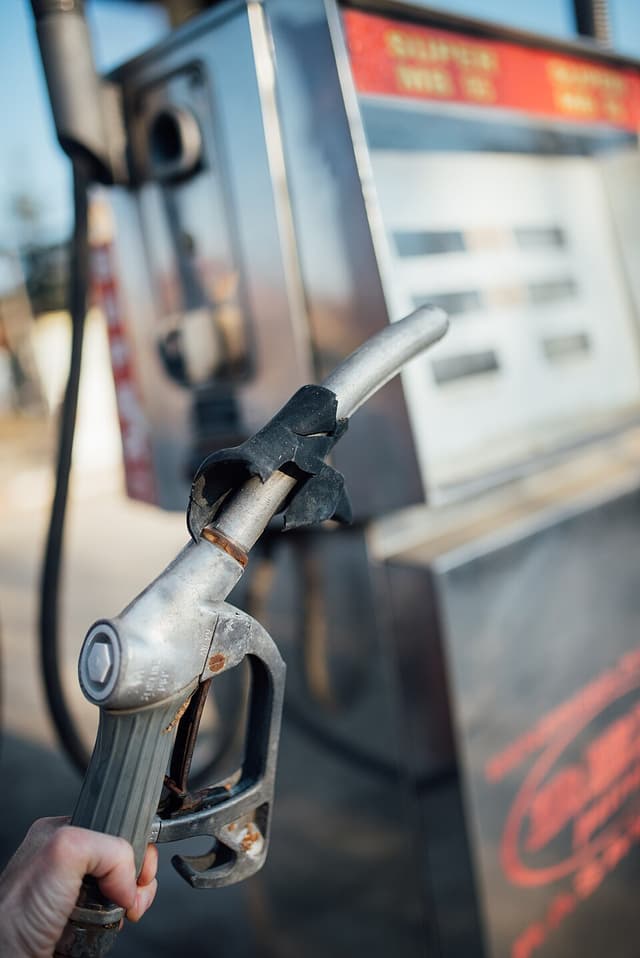
The pump does not know how much fuel is in your tank
You can pull into a gas station with a nearly empty compact car, a pickup truck or an unfamiliar rental vehicle and use essentially the same fuel nozzle. Somehow, when the tank fills, the handle suddenly clicks and the flow stops.
It can seem as if the gas pump has measured your tank, received a signal from the car or calculated how many gallons should fit.
In a conventional automatic fuel nozzle, none of that is necessary.
The nozzle is watching for something much simpler: has liquid reached a small sensing opening near the tip of the spout?
Fuel flowing through the nozzle creates a pressure difference inside the handle. While the sensing opening can draw in air, fueling continues. When rising fuel covers that opening, the pressure changes, a diaphragm moves, a mechanical latch releases and a spring-loaded valve shuts the fuel off.
The famous click is therefore not the pump discovering the capacity of your tank. It is a mechanical system reacting to fuel reaching the nozzle.
Look closely at the end of the nozzle
Near the end of a typical automatic fuel nozzle is a small opening. It is easy to overlook because it is tiny compared with the main opening through which fuel leaves the spout.
That little opening is connected to a narrow internal passage running back through the nozzle.
The Petroleum Equipment Institute describes this as part of the automatic shutoff system. While the vehicle's tank is still accepting fuel normally, air enters the opening near the end of the nozzle and moves through the internal passage.
The nozzle's automatic shutoff depends on whether that path is open to air or covered by liquid.
A feature only a few millimetres across is therefore responsible for one of the most familiar sounds at a gas station.
Flowing fuel creates suction inside the nozzle
The next part of the system comes from fluid dynamics.
Inside an automatic nozzle, flowing fuel passes through a narrowed region that can create a low-pressure area. Fuel-equipment manufacturers and patents commonly describe the shutoff system as using the Venturi principle.
A Venturi is a passage whose changing cross-section causes fluid velocity and pressure to change. In a fuel nozzle, this effect can be used to create suction in the small sensing circuit.
That suction tries to draw air through the tiny opening near the nozzle tip.
As long as the opening remains exposed to air, the system stays in its normal fueling state. Air can continuously enter through the sensing port, preventing the pressure difference from becoming strong enough to trigger the shutoff mechanism.
Then the rising fuel reaches the tiny hole
As gasoline enters the tank, the liquid level eventually rises into the filler neck around the nozzle.
Once fuel covers the sensing hole, air can no longer enter it freely.
The fuel flowing through the nozzle is still creating suction, but the easy supply of outside air has suddenly disappeared. The pressure inside the shutoff circuit changes rapidly.
That pressure change acts on a flexible diaphragm inside the nozzle.
The diaphragm moves enough to release a mechanical trigger or latch. A spring then closes the main fuel valve.
Click.
The fuel flow stops, often within a fraction of a second of liquid blocking the sensing port.
The nozzle is mostly mechanical
What makes the system particularly elegant is how little information it needs.
A traditional automatic nozzle does not have to ask the vehicle how large its fuel tank is. It does not need the dashboard fuel gauge. It does not need Bluetooth, GPS, a camera or a computer model of every car ever made.
The same basic nozzle can work with many different vehicles because it reacts to a physical condition at the filler neck.
The components may include the sensing port, an internal air passage, a Venturi, a pressure chamber, a flexible diaphragm, a latch and a spring-loaded main valve.
Fuel flow itself helps create the signal that ultimately stops the fuel flow.
| Part | What it does |
|---|---|
| Sensing hole | Allows air into the shutoff system until liquid covers it |
| Venturi | Creates a low-pressure region while fuel flows |
| Air passage | Connects the sensing hole to the pressure mechanism |
| Diaphragm | Moves when the pressure difference becomes strong enough |
| Latch and valve | Release and stop the fuel flow |
Why the handle can stay squeezed without you holding it
Many fuel nozzles have a small latch that can hold the operating lever in an open position while the tank fills.
That does not disable the automatic shutoff.
The hold-open mechanism keeps the lever in its fueling position, but the automatic trigger is designed to override it when the diaphragm senses the full-tank condition.
When the shutoff mechanism trips, the internal valve closes even though the external lever appears to have been latched.
That separation is important. The customer controls when fueling begins, but the nozzle retains an independent way to stop the flow when fuel reaches the sensing port.
The gas station is not talking to your fuel gauge
Your dashboard fuel gauge and the gas-station nozzle are essentially solving different problems.
The vehicle's gauge estimates how much fuel is in the tank, commonly using a level sensor located inside the vehicle's fuel system.
The station nozzle does not need that information.
This is why an old vehicle, a brand-new vehicle and a car with an inaccurate dashboard fuel gauge can all still cause an automatic nozzle to click off.
The shutoff happens locally at the filler neck. Once liquid blocks the sensing opening, the nozzle has the information it needs.
It does not actually detect that the entire tank is full
Saying the nozzle detects a "full tank" is convenient, but technically it is detecting fuel at a particular point near its own tip.
Vehicle fuel systems are shaped to make that condition occur when the tank has reached its intended refueling level.
The tank itself may still contain some vapor space. That space is intentional. Liquid fuel changes volume with temperature, and modern fuel systems also have to manage fuel vapor and emissions.
So the first automatic click should not be interpreted as proof that every empty space inside the tank has been filled with liquid.
It means the refueling system has reached the point where the nozzle's automatic shutoff has been triggered.
Why you should not keep topping off after the click
Some drivers respond to the first click by squeezing the handle again, trying to round the price up or squeeze a little more fuel into the tank.
Vehicle manufacturers commonly advise against doing this.
Toyota, for example, tells drivers to stop filling after the nozzle automatically clicks off and specifically warns not to top off the fuel tank.
Continuing after the intended shutoff point increases the chance of fuel spilling or entering parts of the vapor-management system that are not intended to contain liquid gasoline.
The automatic click is not simply an inconvenience built into the nozzle. It is the normal signal that refueling should end.
Your tank also has to let air and vapor escape
There is another piece of the puzzle happening inside the car.
Imagine pouring water rapidly into a sealed bottle. If the air already inside has no way to escape, filling becomes difficult.
A vehicle fuel tank faces a similar problem. As liquid fuel enters, the air and fuel vapor occupying that space have to be displaced.
Modern vehicles contain venting and evaporative-emissions systems designed to manage those vapors rather than simply releasing everything directly into the atmosphere.
During normal refueling, fuel should be able to travel down the filler neck while displaced gas follows its intended vent path.
If that process is disturbed, fuel can back up toward the nozzle before the tank has actually reached its intended fill level.
That is why a pump sometimes clicks off too early
Anyone who has fought with a fuel nozzle that shuts off every few seconds has seen the weakness of the system: the nozzle does not know why its sensing port became blocked.
It only knows that the airflow through that port has been interrupted.
Fuel can splash up the filler neck and temporarily cover the opening. The angle of the nozzle can affect how fuel moves through the neck. A very high flow rate can create more turbulence.
A problem with the vehicle's tank venting can also cause fuel to back up in the filler neck and trigger the nozzle before the tank is genuinely full.
The automatic shutoff is therefore extremely useful, but it is not an intelligent measurement of fuel capacity. It responds to local pressure and liquid conditions near the nozzle.
Why changing the nozzle angle can sometimes change the problem
Drivers sometimes notice that a nozzle which repeatedly clicks off will behave differently if it is inserted slightly farther, pulled back a little or positioned at another angle.
That can happen because the sensing hole's position relative to fuel splashing and the filler-neck geometry has changed.
The effect does not mean the pump suddenly recalibrated itself.
A different position can change how liquid flows past the nozzle tip and how easily displaced air or vapor travels out of the filler system.
If premature shutoff happens constantly with the same vehicle across different filling stations, however, the vehicle's venting or filler system can also be involved. Persistent refueling problems are different from the occasional premature click caused by turbulence.
The click can also protect against a dropped nozzle
Automatic fuel nozzles can contain safety mechanisms beyond the full-tank shutoff.
Husky, a major fuel-equipment manufacturer, describes some of its nozzles as shutting off not only when the tank is full but also if the nozzle falls out of the vehicle's fill pipe or is raised beyond a certain orientation.
Different nozzle models implement these protections differently, so not every nozzle behaves identically.
The broader design goal is the same: once fuel flow becomes unsafe or the expected fueling conditions disappear, the nozzle should stop dispensing rather than depend entirely on the person holding it.
The idea has been around for generations
Automatic shutoff fuel nozzles are much older than digital gas-station displays and modern vehicle electronics.
U.S. patents from the 1940s already describe filling nozzles using a Venturi, a vent passage near the nozzle outlet, a diaphragm and a spring-loaded valve to stop flow when liquid reaches the end of the nozzle.
A 1970 patent describing another automatic shutoff nozzle explains essentially the same recognizable arrangement: flowing gasoline creates suction at a Venturi, air is drawn from an opening near the outlet, and covering that opening changes the vacuum enough to operate the shutoff mechanism.
Modern nozzle designs have added improved safety systems, vapor controls, flow characteristics and more durable components, but the underlying physical trick has been remarkably persistent.
Why the click is so fast
A shutoff system is useful only if it reacts before a meaningful amount of fuel escapes.
That is one advantage of placing the sensing point near the end of the nozzle rather than trying to infer tank fullness somewhere else.
The liquid itself creates the trigger condition at almost the same place where additional fuel is entering.
Once the sensing path is blocked, the pressure change can move the diaphragm and release the valve mechanism very quickly.
Patents describing these systems emphasize the rapid mechanical release of the fuel-control valve once the sensing circuit is interrupted.
There is no need to wait for a computer to receive a measurement, process it and send a command back to the dispenser.
Fuel flow creates the signal that stops fuel flow
The most satisfying part of the mechanism is its circular logic.
Fuel rushing through the nozzle creates the low-pressure condition used by the sensing system.
That system continuously asks one basic physical question: can air still enter through the hole near the nozzle tip?
For most of the fill, the answer is yes.
Then the fuel rises high enough to cover the hole. The airflow stops, the pressure changes, the diaphragm moves, the latch releases and the valve snaps closed.
No tank-size database is required. No electronic conversation with the car is required. The nozzle does not even need to know whether it has pumped five litres or fifty.
It only needs a tiny hole, moving fuel and a clever use of pressure.