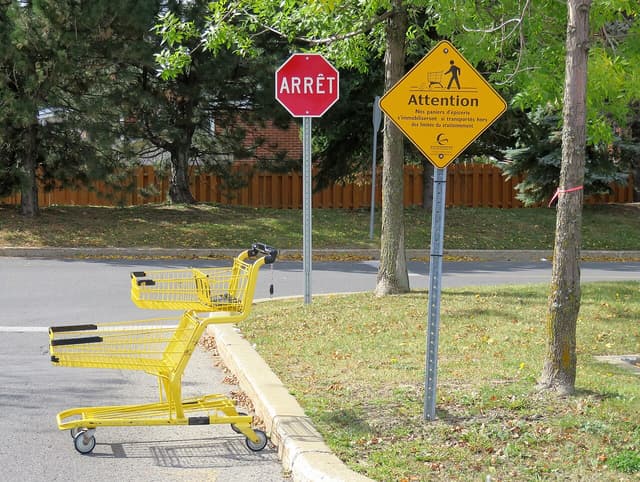
The cart usually does not know where it is
Push certain shopping carts far enough across a supermarket parking lot and something strange can happen. One wheel suddenly refuses to turn. The cart becomes awkward or nearly impossible to push, even though there is no visible barrier in front of it.
It can feel as if the cart somehow knows that it has reached the edge of the property.
In many systems, it does not know its geographic location at all. There is no need for the wheel to look up GPS coordinates, connect to a cellular network or constantly report its position to the store.
Instead, the property itself contains an invisible electronic boundary. When a receiver inside the cart wheel detects the signal from that boundary, a locking mechanism engages.
The clever part is not teaching thousands of shopping carts where the parking lot ends. It is giving each cart a simple way to recognize one specific line.
The unusual-looking wheel contains the electronics
Stores using a containment system do not necessarily modify every part of the cart. Often, one of its wheels is replaced with a much more complicated wheel assembly.
Inside that wheel can be a receiver, electronic circuitry, a battery and a mechanism capable of restricting the wheel's rotation.
Gatekeeper describes its SmartWheel as containing a signal receiver and locking mechanism. When the wheel detects the appropriate locking signal from the perimeter antenna, the mechanism activates.
That is why a cart with anti-theft technology may have one wheel that looks noticeably bulkier than the others.
The ordinary wheels are still just wheels. The special one is effectively a small battery-powered electronic device disguised as part of the caster.
Crossing the boundary triggers the lock
As the cart approaches the perimeter, the receiver inside the wheel begins to encounter the electromagnetic signal associated with the buried antenna.
When the electronics recognize the correct signal, they command the locking mechanism to engage.
Earlier patented systems describe variations of the same basic idea: a wire defines a permitted area, the wire produces an electromagnetic field, a sensor on the cart detects that field, and a mechanical device stops or restricts the wheel.
Modern implementations can differ in their electronics and mechanical design, but the basic experience for the shopper is simple. The cart rolls normally inside the permitted area and becomes difficult to move when it reaches the boundary.
The wheel is reacting to a signal, not calculating that it has travelled a particular number of metres from the store.
It is closer to crossing an invisible tripwire than using GPS
GPS would seem like an obvious modern solution, but it would solve a much harder problem than the store actually has.
A supermarket generally does not need to know whether a cart is at latitude 40.7128 or 40.7129. It only needs to know whether the cart has crossed a particular boundary.
A perimeter system turns that into a binary question: has the wheel encountered the boundary signal or not?
This has several practical advantages. The store controls the exact shape of the boundary. The system can work beneath trees, beside buildings and in other places where satellite positioning might be unnecessary or inconvenient. The cart also does not need a mobile-data subscription or a constantly running location service.
The wheel can spend most of its life doing almost nothing electronically until it encounters a signal it has been designed to recognize.
| Possible approach | What the cart would need to determine | Typical containment system |
|---|---|---|
| GPS | Its geographic position | Usually unnecessary |
| Distance tracking | How far the cart has travelled | Would not reliably define the property edge |
| Perimeter signal | Whether it has reached a defined boundary | Common approach |
The wheel does not necessarily become completely immovable
People often describe the system by saying that the wheel "locks," but the physical effect can vary with the design.
Some mechanisms inhibit the wheel strongly enough that normal pushing becomes impractical. A loaded shopping cart with one wheel refusing to rotate is difficult to drag very far across asphalt.
That is usually enough. The goal is not to anchor the cart permanently to the ground. It is to make removing it inconvenient enough that the shopper leaves it behind.
Patents for cart-containment technology describe several ways of accomplishing this, including mechanisms that move an inhibitor or brake into position inside or against the wheel.
The electronics detect the boundary, but a mechanical part ultimately has to turn that electronic signal into resistance at the wheel.
Why not just lift the locked wheel?
Anyone who encounters a locked cart may immediately notice a loophole: if only one wheel is locked, couldn't you tilt the cart and keep moving?
That problem has not gone unnoticed.
Some cart-containment installations add an anti-tilt component near another wheel. Gatekeeper's system documentation, for example, lists an anti-tilt bar intended to make it harder to defeat the locked wheel by tipping the cart backward.
A determined person may still find ways to move a cart that was never designed to be an immovable security device. The system is primarily a deterrent and containment mechanism, not a vault.
For ordinary use, however, suddenly losing a functioning wheel is enough to make pushing a shopping cart beyond the boundary unpleasant and conspicuous.
Store employees can unlock it without taking the wheel apart
A store occasionally needs to recover carts that have reached the perimeter, so the locking system has to be reversible.
One method is a handheld electronic remote. Gatekeeper calls its version the CartKey. Employees can point it toward the special wheel and send an unlock command.
The manufacturer's current FAQ gives the CartKey a working range of roughly 18 inches to 4 feet, or about 46 centimetres to 1.2 metres. The relatively short range helps employees control the intended wheel without accidentally affecting carts farther away.
Some installations also have an unlock boundary. A locked cart brought into the appropriate area can receive another signal telling the wheel to release.
This lets staff recover carts from the edge of the property and return them to normal service without physically dismantling the locking mechanism.
The wheel has its own battery
The hidden electronics need power, but there is obviously no charging cable running from a shopping cart to the supermarket.
The special wheel therefore carries its own battery.
Battery life matters enormously in this application. A retailer might operate hundreds of carts, and replacing wheel batteries every few months would turn a clever security system into a maintenance problem.
Gatekeeper says the battery in its SmartWheel 2.0 is designed to last at least five years under normal cart-containment and related use. Its current design uses a non-replaceable battery inside the wheel assembly.
That long life is possible partly because the wheel is performing a relatively narrow task. It does not need to behave like a smartphone with a bright screen, continuous internet connection and powerful processor.
What happens if the buried wire breaks?
An invisible boundary still depends on physical infrastructure, and parking lots are not gentle environments.
Construction crews cut pavement. Asphalt is resurfaced. Drainage work is performed. Utility lines are repaired. All of those activities can potentially interfere with a cable embedded beneath the surface.
Gatekeeper's maintenance documentation lists a damaged perimeter antenna as one possible reason multiple wheels might stop locking or unlocking correctly at the boundary.
Its troubleshooting instructions even tell staff to take note of nearby construction or unusual activity when diagnosing problems.
So when every cart suddenly stops recognizing one section of a parking lot, the problem may not be the carts at all. The invisible fence itself may have been interrupted.
Why a cart can sometimes lock where you did not expect
From the shopper's point of view, the boundary may seem arbitrary because there is no physical wall showing exactly where the electronics are installed.
The containment line is determined by the antenna installation, not by the shopper's idea of where the parking lot should end.
A store can place warnings or painted markings near common exits, but the protected perimeter may extend around the entire property.
System faults can also happen. A wheel can require resetting, an antenna can be damaged, or a particular section of the perimeter can behave differently from another. Manufacturer troubleshooting guides include procedures for testing carts at several separate points along the boundary for exactly this reason.
The technology is reliable enough to be commercially useful, but it is still a collection of real electronics, batteries, cables and moving parts operating outdoors.
The idea is much older than smartphone tracking
Electronic cart containment can feel like a product of the GPS era, but the underlying idea is much older.
A U.S. patent filed in 1958 described an anti-theft cart device intended to confine carts within an area bounded by magnetic material. Crossing that magnetic boundary would release a wheel-locking mechanism.
Later systems became electronic. Patents from the 1990s described shopping-cart boundaries formed by wires producing electromagnetic fields, with sensors near a cart wheel activating a brake or inhibitor.
The technology has continued to evolve, but the basic insight has survived for decades: it is easier to mark the edge of the permitted area and make the cart respond to that edge than to continuously track every cart everywhere.
What looks like a modern location-aware wheel is really the latest version of an old containment problem.
Keeping carts in the parking lot is not the same as stopping shoplifting
There are actually two different problems that shopping-cart technology can address, and they are easy to confuse.
A cart-containment system tries to stop the cart itself from leaving the retailer's property. Its boundary may be around the parking lot.
A pushout-prevention system tries to detect carts containing unpaid merchandise as they approach or leave a store exit.
Those systems can use additional information. Modern retail-security technology can combine wheel locking with checkout activity, sensors, cameras or computer vision to decide whether a cart leaving the building appears suspicious.
Recent patents describe computer-vision systems capable of examining whether a basket or cart contains merchandise before deciding whether to trigger an anti-theft action.
So not every cart that suddenly locks is responding to the same event. A wheel can be part of a property-containment system, an in-store loss-prevention system, or technology that supports both.
Some modern carts can be much smarter
The simple perimeter-wire design does not represent everything retailers can do with shopping carts today.
Carts can be equipped with electronics for tracking usage, managing fleets, detecting unauthorized exits or communicating with other store systems. Patents describe technologies that monitor cart movement and combine wheel assemblies with other electronic equipment.
Computer vision adds another layer. A camera watching an exit can potentially distinguish an empty cart from one loaded with merchandise and use that information as part of a theft-prevention decision.
That does not mean the ordinary locking wheel at the edge of a parking lot is secretly running artificial intelligence.
It means a device that began with a very simple question, whether the cart crossed a boundary, can now become one component in a much larger retail-security system.
Why stores bother locking the carts at all
A shopping cart looks simple, but to a retailer it is reusable equipment that has to be purchased, stored, maintained and kept available for customers.
When carts leave the property, they can be abandoned several streets away, damaged, stolen for scrap or personal use, or collected later at the store's expense.
A missing cart also creates a second problem. Even if it is eventually recovered, it is unavailable to shoppers while it is gone.
Containment systems attempt to prevent that loss before retrieval becomes necessary. Instead of locating a missing cart after it has travelled away from the store, the system tries to make leaving the property difficult in the first place.
That explains why these systems often care far more about the parking-lot boundary than the precise location of the cart within it.
The wheel knows the line, not the map
The next time a shopping cart wheel suddenly locks near the edge of a supermarket property, the most interesting technology may be underneath your feet rather than inside a satellite navigation system.
A transmitter can energize a cable buried beneath the pavement. A receiver hidden inside one wheel listens for the encoded boundary signal. When the cart reaches that line, the wheel's electronics activate a mechanical brake or locking mechanism.
Employees can later release it with a handheld device or, at some locations, by moving the cart through a separate unlocking boundary.
The cart does not need to understand streets, coordinates or even the shape of the parking lot.
It only needs to recognize one invisible line.