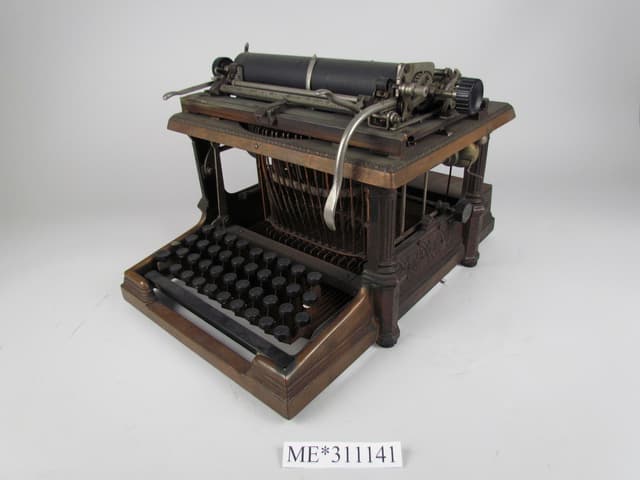
The keyboard did not begin with QWERTY
Look at the first row of letters on a modern English keyboard and you get Q, W, E, R, T, Y. There is no obvious alphabetical pattern, and nothing about a computer requires those six letters to appear together.
That is because the layout is older than the computer by about a century. QWERTY was developed for mechanical typewriters, then inherited by later generations of typing machines and eventually by electronic keyboards.
Early typewriter experiments were much closer to alphabetical order. Smithsonian Magazine describes one early Sholes and Glidden prototype with letters arranged in a mostly sequential pattern across two rows.
During years of experimentation, that simple arrangement changed repeatedly. By the time the first commercially successful typewriters reached the market in the 1870s, the keyboard was beginning to resemble the QWERTY layout we still use.
The strange order on your laptop is therefore not a design created for laptops. It is a surviving part of 19th-century machinery.
The first layouts were much easier to recognize
Christopher Latham Sholes was a Wisconsin newspaper publisher, politician and inventor. In the 1860s, he worked with Carlos Glidden and Samuel Soule on machines that eventually developed into a practical typewriter.
Their earliest designs did not begin with the familiar three rows of QWERTY letters. Smithsonian records show that the inventors experimented with several mechanisms, while Smithsonian Magazine describes an early keyboard whose letters were still largely arranged in sequence.
That makes intuitive sense. If people already know the alphabet, putting A near B and B near C seems like an obvious way to help a new user find the keys.
But a mechanical typewriter has needs that an alphabet chart does not. Pressing a key has to move a piece of machinery, strike the correct character against paper and return without interfering with the next keystroke.
As the typewriter mechanism evolved, the keyboard evolved with it.
Early typewriters had moving typebars
On many early typewriters, pressing a key caused a metal typebar carrying a letter to swing toward the paper.
The machine therefore had to coordinate dozens of mechanical parts in a small space. If two typebars moved into the same area at nearly the same time, they could interfere with one another.
This mechanical problem is the basis of the most familiar explanation for QWERTY. According to that account, frequently used letter combinations were rearranged so that neighboring typebars were less likely to collide during rapid typing.
The Smithsonian's National Museum of American History describes the commercially successful Remington No. 2 as using QWERTY primarily to help prevent typebar jamming rather than to increase typing speed.
There is good historical reason to take the mechanical problem seriously. The part that becomes shaky is when the story is simplified into the claim that QWERTY was intentionally designed to make people type slowly.
QWERTY was not simply a plan to slow typists down
The popular version of the story usually goes like this: early typists became too fast, their machines jammed, so the inventor deliberately created an inefficient keyboard to slow everyone down.
That version is too neat.
Slowing the user was not the same thing as designing a layout that worked reliably with the machine. A typewriter manufacturer wanted people to produce useful text efficiently. A machine that jammed constantly was not useful, but neither was a keyboard intentionally made frustrating to operate.
More importantly, historians do not agree that typebar separation alone explains the final arrangement.
Smithsonian sources describe the origin of the exact QWERTY pattern as disputed. Sholes and his collaborators went through many experimental layouts, and the surviving documentation does not contain one simple statement explaining why every letter ended up where it did.
So it is reasonable to say that mechanical constraints influenced the keyboard. It is much harder to defend the stronger claim that QWERTY exists because its inventors wanted typists to be slow.
Telegraph operators may have influenced the layout too
Another explanation comes from the relationship between early typewriters and telegraphy.
Researchers Koichi Yasuoka and Motoko Yasuoka of Kyoto University studied the development of QWERTY alongside 19th-century telegraph equipment. Their research argues that the familiar slowing-down explanation does not adequately describe the keyboard's history.
Telegraph operators were important early users of typing technology. They listened to coded transmissions and needed to turn incoming signals into written language quickly and accurately.
The Yasuokas argue that keyboard development was connected with telegraph practice and that the arrangement changed repeatedly as inventors responded to different practical requirements. In their account, QWERTY emerged gradually rather than from one clean design rule.
Smithsonian's more recent history of QWERTY also presents the telegraph explanation alongside the traditional jamming explanation instead of claiming that historians have settled the question completely.
The layout changed many times before QWERTY settled down
It is easy to imagine Christopher Sholes sitting down one afternoon, writing QWERTY across the top of a drawing and inventing the modern keyboard in one step. The historical process was much messier.
Smithsonian Magazine reports that Sholes and his collaborators built around 30 experimental models. Key positions moved as the machine changed.
One surviving intermediate arrangement was almost QWERTY but placed a period where the R would later appear, producing something closer to QWE.TY across part of the top row.
That detail is revealing. The familiar layout was not sacred even to the people developing it. Letters and punctuation were still being moved while the typewriter was being refined.
Eventually the arrangement converged on something close to modern QWERTY, but even early commercial keyboards were not identical in every detail to the keyboard on a laptop today.
Remington turned an experimental layout into a product
An invention becomes much harder to change once a large company starts manufacturing it for customers.
Sholes and Glidden reached an agreement with E. Remington & Sons, a manufacturer with the equipment needed to build the machines commercially.
The Sholes and Glidden typewriter went on sale in 1874. Often known later as the Remington No. 1, it became the first commercially successful typewriter and placed the emerging QWERTY arrangement in front of real customers.
The Remington No. 2 followed in 1878. It included a QWERTY keyboard and introduced an important feature that survives on keyboards today: a shift mechanism that allowed the same key to produce uppercase and lowercase letters.
Commercial success changed the problem. QWERTY was no longer one experimental arrangement among many. People were buying machines that used it, businesses were building workflows around it, and typists were learning where its keys were.
A keyboard layout becomes valuable when other people know it
Keyboard layouts have an unusual property: familiarity itself makes them useful.
Imagine that two layouts are available. One is theoretically a little more efficient, while the other is already used by most offices, typing schools and manufacturers.
Choosing the less common layout has a cost. Workers need retraining. Typists cannot move as easily between machines. Schools need different lessons. Manufacturers risk selling machines that customers do not know how to operate.
By the late 19th century, QWERTY had accumulated exactly this kind of advantage.
Smithsonian Magazine reports that Remington claimed more than 100,000 of its QWERTY-based machines were in use by 1891. In 1893, several major typewriter manufacturers joined in the Union Typewriter Company, further strengthening QWERTY as an industry standard.
At that point the layout's history mattered less than its installed base. Millions of fingers were beginning to learn it.
Typing schools helped lock the layout into muscle memory
Typewriters also created a new professional skill: typing itself.
During the 1880s, typing schools expanded as businesses hired workers specifically to produce correspondence and records on typewriters. Learning a keyboard became part of job training.
That made switching layouts more expensive. A trained typist does not search for every letter consciously. Repeated practice turns sequences of movements into muscle memory.
If a company replaced every QWERTY machine with a different layout, experienced workers could suddenly become beginners again.
A familiar layout therefore has value beyond the arrangement of its individual keys. It carries the accumulated practice of everyone who has already learned it.
QWERTY was challenged by alternative keyboards
People have repeatedly tried to design layouts that improve on QWERTY.
One of the best-known alternatives is the Dvorak keyboard, developed by August Dvorak and William Dealey during the 20th century. It places many commonly used letters on the home row and was designed to reduce unnecessary finger movement.
Other layouts have pursued similar goals, including improved comfort, faster typing, better hand alternation or adaptation to particular languages and devices.
Arguments over exactly how much these alternatives improve real-world typing can become surprisingly contentious. Performance depends on the typist, training, language, task and what is being measured.
The more important historical point is that QWERTY did not remain dominant because nobody ever thought of another arrangement. Alternatives arrived after QWERTY already had an enormous network of machines, trained users, schools and manufacturers behind it.
Why computers kept a layout designed for typewriters
Once keyboards became electronic, the mechanical typebar problem disappeared. A computer does not have metal arms swinging toward a sheet of paper, so there is no physical need to keep particular letters apart.
This would have been an obvious opportunity to replace QWERTY with something entirely new.
Instead, computer manufacturers inherited the keyboard people already knew.
That choice was practical. Secretaries, programmers, writers, office workers and data-entry staff had spent decades learning QWERTY. Existing typing courses taught it. Businesses expected it. Requiring every computer user to relearn typing would have imposed a large cost for an uncertain improvement.
Teletypes and other keyboard-driven communication equipment also connected the typewriter era with early computing. By the time personal computers arrived, QWERTY was already embedded in the culture of text entry.
Why phones still use QWERTY when they have no physical keys
The strangest part of QWERTY's survival may be the smartphone.
A touchscreen has none of the mechanical restrictions of a 19th-century typewriter. Software can place letters anywhere, resize them instantly, predict words and even replace the entire keyboard with another input method.
Yet an English-language phone keyboard usually opens with QWERTY.
The reason is familiarity. Most users already know approximately where each letter is. Moving A, E, T and the rest into alphabetical order would force people to search for keys they currently locate almost automatically.
Software keyboards have changed many other things instead. They use autocorrect, prediction, swipe typing, variable key targets and language models while leaving the visible letter arrangement familiar.
The hardware constraint disappeared, but the learned convention remained valuable.
Would alphabetical order actually be easier?
Alphabetical order seems simpler because everyone learns ABC before learning QWERTY. For a person who has never used a keyboard, that can indeed make individual letters easier to find at first.
Typing, however, is not mainly a letter-finding task once someone becomes experienced.
A practiced typist learns positions rather than reciting the alphabet to locate each key. Common words become coordinated finger movements, and rearranging the keyboard destroys those learned patterns.
An alphabetical layout also does not automatically optimize the movements needed for ordinary language. Letters that happen to sit next to each other in the alphabet are not necessarily letters that benefit from being close together during typing.
That is why the question is not simply QWERTY versus ABC. Keyboard design can optimize for many different goals, including learning, finger movement, alternating hands, ergonomics, language frequency, one-handed use and touchscreen interaction.
QWERTY became a standard before anyone knew what a computer was
The history of QWERTY is a useful example of how technologies inherit decisions from earlier technologies.
The letters were arranged while inventors were trying to make mechanical typewriters practical. The resulting machines became commercially successful. Businesses bought them, typing schools trained people on them, competitors adopted compatible layouts, and generations of users memorized the arrangement.
Then teletypes, terminals, electronic typewriters and computers arrived one after another. Each new technology had the option to start over, but keeping the familiar keyboard usually imposed less disruption than replacing it.
By the time there was no mechanical reason for QWERTY at all, there were powerful social and economic reasons to preserve it.
The layout became infrastructure.
So why aren't the letters alphabetical?
Because the modern keyboard is the descendant of a machine, not an alphabet chart.
Early typewriter inventors did experiment with more sequential arrangements, but the layout changed as they refined the mechanism and tested the machine with real uses. Mechanical typebar behavior was one factor, and historical research also points to the needs of telegraph operators and the broader process of experimentation.
QWERTY then reached the market at the right moment. Remington sold successful machines using it, typists learned it, businesses standardized around it and later technologies inherited it.
There is no good evidence that the whole layout was created simply to punish fast typists. The actual story is less tidy and more interesting: an experimental solution became a commercial standard, and the cost of changing it grew every year.
That is why a touchscreen phone in the 21st century still carries the fingerprint of a mechanical typewriter built in the 19th.