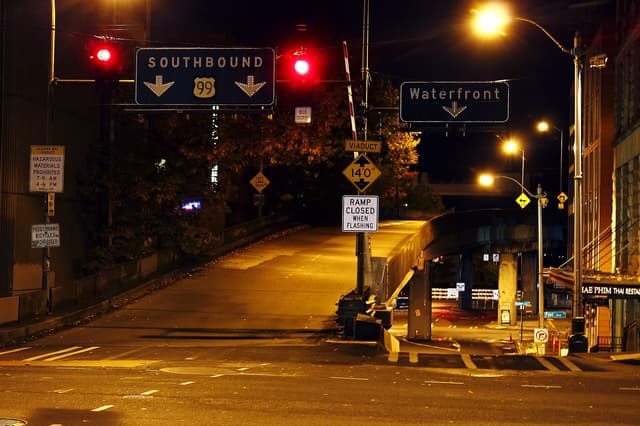
The sign is not producing the light
Drive along a dark road and a sign can suddenly appear almost luminous. A speed-limit sign may turn brilliant white. A warning sign becomes vivid yellow. A green direction sign can look far brighter than the trees, barriers and buildings around it.
Most of those signs contain no lamp, battery or electrical connection. They are not glowing in the way an LED display or illuminated billboard does.
The light is coming from your own vehicle.
Road signs are covered with material designed to send a large portion of your headlight beam back in roughly the direction it came from. Because your eyes are sitting close to the headlights, much of that returned light reaches you.
The effect is called retroreflection, and it is one of the reasons an ordinary sheet of road-sign material can appear almost electrically illuminated at night.
Ordinary objects reflect light very differently
To understand why a road sign looks unusual, it helps to compare three ways a surface can handle incoming light.
A rough wall produces diffuse reflection. Light strikes the surface and scatters in many directions. That lets people view the wall from almost anywhere, but only a small part of the original light returns toward any particular observer.
A smooth mirror produces specular reflection. Light leaves the mirror at a predictable angle. If you stand in the correct position, the reflection can be extremely bright. Move away from that angle and it disappears.
A retroreflective surface behaves differently from both. It is designed to return incoming light toward the direction from which the light arrived.
For a driver, that means light leaving the headlights reaches the road sign and much of it is directed back toward the vehicle.
| Surface | What happens to incoming light | Typical example |
|---|---|---|
| Diffuse | Light is scattered in many directions | Painted wall |
| Specular | Light reflects at a particular angle | Mirror |
| Retroreflective | Light is directed back toward its source | Traffic sign |
A road sign is covered in tiny optical devices
The surprising part is what creates the effect. The reflective face of a road sign is not simply a sheet of shiny paint.
Retroreflective sign sheeting contains enormous numbers of tiny optical elements. Depending on the material, these may be microscopic glass beads or tiny prism-like structures.
Each element handles only a small amount of incoming light. Across the entire sign, however, millions of these elements work together and the surface appears uniformly bright from the driver's position.
The Federal Highway Administration broadly divides retroreflective sign technology into materials based on microsized glass beads and materials based on microsized prisms.
Both are solving the same problem: take light arriving from a vehicle and efficiently return enough of it toward that vehicle for the driver to read the sign.
Glass beads can bend light back toward the car
One of the older approaches uses extremely small transparent glass spheres.
When light enters a glass bead, it bends because light travels differently through glass than through air. The geometry of the bead focuses the incoming light toward the rear of the sphere, where it can be reflected and sent outward again.
With the bead and backing arranged correctly, much of that returning light travels back toward the direction it originally came from.
A single bead is tiny, but a reflective surface can contain a huge number of them. The driver does not see thousands of individual bright points. At normal viewing distance, they merge into what looks like one brightly illuminated sign.
Glass beads have also been widely used in reflective road markings. Similar optical principles allow headlight illumination to return toward the driver from painted lane markings.
Modern signs can use microscopic corner reflectors
Many newer high-performance sign materials use microprismatic structures instead of relying entirely on glass beads.
A common optical idea is the corner-cube retroreflector. Imagine the inside corner where three square surfaces meet at right angles. A light ray entering that geometry can reflect from the three perpendicular surfaces and leave traveling back toward where it came from.
NASA uses the same fundamental optical principle in descriptions of cube-corner retroreflectors used for precision measurement. After reflections from three mutually perpendicular surfaces, the components of the incoming ray are reversed and the light travels back toward the source.
Traffic-sign sheeting miniaturizes retroreflective structures so that huge numbers can fit across a thin flexible surface.
You do not see the individual prisms while driving. You see their combined result when the sign suddenly becomes bright in your headlights.
The light does not return to exactly one point
There is an important detail hidden in the phrase "back toward the source." Your eyes are not located inside the headlight bulbs.
The headlights are lower and farther apart, while the driver's eyes sit higher and nearer the center of the vehicle.
If a road sign sent every photon precisely back into the headlight that produced it, the lamp would receive the reflection but the driver might see much less of it.
Real sign materials return light within a small cone around the source direction. That controlled spread allows the reflected beam to reach the driver's eyes as well as the region around the headlights.
Older U.S. traffic-sign guidance explicitly described this requirement. A useful reflector should send light into a narrow cone with enough divergence to reach the driver's normal eye position above the headlamps.
That is why the driver gets the best view
Retroreflection creates a strange viewing effect. A sign can appear brilliantly bright to the driver whose headlights are illuminating it while looking much less impressive to someone standing well away from the vehicle.
The observer closest to the incoming light source receives the strongest returned beam.
This also explains why reflective signs can look spectacular in photographs taken with a camera flash. The flash is positioned close to the camera lens, so the illumination and the observer are almost in the ideal retroreflective geometry.
Move the light source far away from the camera and the same material may look dramatically less bright.
The sign has not changed. The geometry has.
A road sign cannot glow in complete darkness
Retroreflective material does not create energy, and it normally does not store daylight for later use.
If you placed a normal retroreflective road sign in complete darkness with no headlights, streetlights or other illumination, it would remain dark.
Turn on a flashlight near your eyes and the sign can suddenly appear bright. Turn the light off and the brightness disappears immediately.
That separates retroreflection from phosphorescence, the glow-in-the-dark effect found in materials that absorb energy and continue releasing some of it after the original light source has gone.
A normal reflective traffic sign is better thought of as an unusually efficient optical return system. It needs incoming light before it can look bright.
Why the sign keeps its red, yellow or green color
If headlights are roughly white, why does a stop sign return red light while a warning sign remains yellow?
Retroreflective sheeting can include colored pigments, films or other optical layers that control which wavelengths reach the observer. The retroreflective structure determines where much of the light goes, while the colored material determines the color that emerges.
This lets a traffic sign keep a similar visual identity during the day and at night.
The contrast is equally important. Dark parts of a sign typically return far less light than the retroreflective colored or white areas around them, allowing letters and symbols to remain readable.
The result is not simply brightness. The sign must return enough light while preserving the shapes, colors and contrast drivers rely on to recognize its meaning quickly.
Traffic signs have been using this trick for decades
Nighttime sign visibility became a road-design problem long before modern microprismatic films existed.
The first edition of the U.S. Manual on Uniform Traffic Control Devices appeared in 1935, and Federal Highway Administration histories note that nighttime visibility requirements have appeared throughout the manual's history.
By the 1948 edition, the manual described several approaches to reflectorization. Signs could use individual reflector buttons made from glass or transparent plastic, or reflecting coatings containing large numbers of tiny glass spheres.
The manual explained that the important property was what it called retrodirective reflection: light was concentrated back around the direction of the incoming beam rather than scattered broadly.
The materials improved dramatically over the following decades, but the problem being solved remained the same. A driver needed to see important information at night without every roadside sign requiring its own electrical lighting system.
Not every road sign relies entirely on reflection
Retroreflection works especially well on signs mounted near the side of the road because vehicle headlights can illuminate them at useful angles.
Large overhead signs create a harder problem. They may sit high above the roadway while modern low-beam headlights deliberately direct much of their light downward to reduce glare for other drivers.
The current U.S. Manual on Uniform Traffic Control Devices requires the letters, numerals, symbols, arrows and borders of freeway and expressway guide signs to be retroreflective. It also requires backgrounds to be retroreflective when the sign is not independently illuminated.
The same standard notes that overhead signs can receive relatively little illumination from low-beam headlights and recommends illumination when an engineering study does not show that retroreflection alone will perform effectively.
So the answer to the original question is not that every sign uses no electricity. Many ordinary signs need none, while certain installations can still use dedicated lighting.
Road signs get dimmer as they age
A retroreflective sign does not stay equally bright forever.
Sunlight, weather, dirt, physical damage and deterioration of the reflective material can gradually reduce its nighttime performance. The color of the sign can fade as well.
The Federal Highway Administration notes that retroreflectivity deteriorates over time, reducing the distance from which a sign can be detected and read at night.
Weather at the moment of driving matters too. Dew or frost on the sign, rain, fog, the condition of the windshield and the exact angle between the vehicle and sign can all influence how much light eventually reaches the driver's eyes.
This creates an unusual maintenance problem. A sign can still look reasonably normal during the day while its nighttime optical performance has deteriorated enough to matter.
Engineers can actually measure how reflective a sign is
Road agencies do not have to judge sign performance only by looking at it.
Retroreflectivity can be measured using instruments called retroreflectometers. For traffic signs, the measurement is commonly expressed as a coefficient of retroreflection, represented as RA.
The measurement relates the brightness returned from the material to the amount of illumination reaching it under a defined viewing geometry.
That geometry matters because changing the positions of the light source, sign and observer changes how much returned light reaches the observer.
U.S. traffic standards include minimum maintained retroreflectivity levels for important categories of signs, giving road agencies a way to manage signs as their reflective materials age.
Why reflective signs matter more at night than they seem to
During daylight, signs have an enormous source of illumination: the sky and Sun. At night, a driver sees only a small part of the environment illuminated strongly by vehicle headlights and road lighting.
That makes contrast and visibility much harder to maintain.
FHWA notes that roughly half of traffic fatalities occur at night even though only about one quarter of travel takes place after dark. Many factors contribute to the difference, including reduced visibility, fatigue and impairment.
Retroreflective traffic signs and pavement markings cannot solve every nighttime safety problem, but they make important information visible from greater distances using light that the vehicle is already producing.
That is a remarkably efficient piece of road engineering. Instead of powering millions of ordinary signs, the road system can borrow a little light from every approaching vehicle and send it straight back.
The brightest thing on the road may contain no light at all
The next time a road sign seems to flare into view at night, notice what happens as your headlights sweep across it.
The sign is not switching on. Microscopic optical structures in its surface are catching part of the headlight beam and returning it toward the vehicle.
Glass beads can bend and redirect light. Tiny prisms can reverse its direction through carefully arranged reflections. Across an entire sign, those structures produce enough returned light to make the surface appear dramatically brighter than its surroundings.
Move the light source away, and much of the apparent glow disappears.
What looks like electricity is really geometry, materials science and a beam of light completing a round trip from your car to the sign and back again.