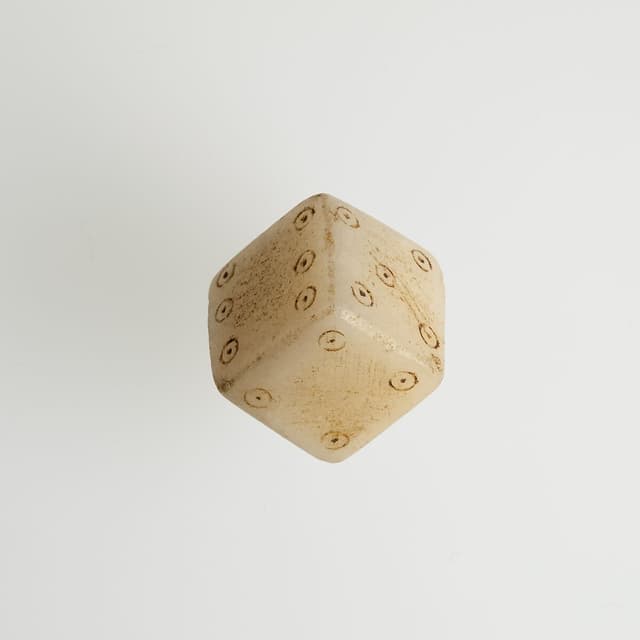
A standard die has three opposite pairs
Pick up an ordinary six-sided die and look at the face opposite 1. It will usually be 6. The face opposite 2 is 5, and 3 sits opposite 4.
Every pair adds to seven.
The arithmetic is easy to see. Pair the lowest number with the highest, then move inward: 1 + 6 = 7, 2 + 5 = 7, and 3 + 4 = 7.
What is less obvious is why dice are numbered this way in the first place. A cube does not require those particular numbers to face each other, and changing their positions does not automatically make a die more or less random.
The seven pattern is a convention. It has a very long history, became widespread enough to be treated as the normal arrangement, and is now written directly into specifications for some modern gaming dice.
Seven is the natural constant if low and high numbers are paired
A six-sided die carries the numbers 1 through 6. If the goal is to place the smallest and largest values opposite each other, there is only one obvious pattern.
| Low value | Opposite high value | Sum |
|---|---|---|
| 1 | 6 | 7 |
| 2 | 5 | 7 |
| 3 | 4 | 7 |
The arithmetic explains the pattern, but not its history
It is tempting to stop at the neat mathematics and assume that someone invented the modern die by deciding that every opposite pair should total seven.
The archaeological record is less tidy.
Cubic dice have existed for thousands of years, and their makers did not always agree on where the numbers should go. Researchers studying ancient dice have identified several recurring numbering systems.
One arrangement is the familiar Sevens configuration: 1 opposite 6, 2 opposite 5, and 3 opposite 4.
Another places consecutive values opposite one another: 1 opposite 2, 3 opposite 4, and 5 opposite 6. Researchers sometimes call this the Primes configuration because the opposite pairs total 3, 7 and 11.
There are other possibilities as well. A cube gives plenty of room to rearrange six labels while still using every number exactly once.
Some very ancient dice already used the seven pattern
The familiar arrangement is far older than modern casinos or factory-made board games.
The Ashmolean Museum holds a terracotta die from Mohenjo-daro in the Indus Valley, dated to roughly 2500 to 1900 BCE. Its opposite sides add to seven, just as they do on many modern dice.
That does not mean every Indus die used the same pattern. Dice from ancient sites show considerable variation, which is one reason the surviving objects are useful to archaeologists studying how games and manufacturing traditions changed.
The Metropolitan Museum of Art notes that cubic dice were already being used in the ancient Near East during the third millennium BCE and that different systems for distributing the pips appeared at different times.
So the seven arrangement is genuinely ancient, but ancient dice were not governed by one universal international standard.
The pattern became much more common later
By the Greco-Roman world, the arrangement we recognize today had become much more familiar.
The Metropolitan Museum of Art describes Roman-period dice whose opposite faces follow 1 and 6, 2 and 5, and 3 and 4. The museum notes that this arrangement came into more general use later in the history of cubic dice.
The British Museum also has Roman examples explicitly catalogued with opposite sides adding to seven.
Archaeological studies support the same general picture. Research on Roman dice describes the Sevens configuration as common, although ancient and medieval dice from different regions still show other arrangements.
Standardization therefore happened gradually. The modern pattern did not suddenly replace every other numbering system at one identifiable moment.
Medieval dice did not always follow the modern rule
The history becomes even less linear after Rome.
Archaeological work on European dice has found periods and regions where another configuration became common. Medieval dice in parts of northwestern Europe, for example, often used opposite consecutive pairs rather than the seven arrangement.
Later examples in those regions moved back toward the Sevens configuration that dominates modern Western dice.
That matters because it rules out the idea that opposite faces adding to seven is an unavoidable property of a properly made die. People used other layouts for real games over long periods of history.
What eventually became standard was one successful convention among several workable possibilities.
Does adding to seven make a die fair?
No. The numbering arrangement by itself does not make a six-sided die fair.
Imagine a perfectly symmetrical cube where each face has exactly a one-in-six chance of landing upward. You could swap the labels 1 and 2, or completely rearrange all six numbers, and each label would still have a one-in-six probability as long as every number appeared on one face.
Fairness depends on the physical die and the way it is rolled. Shape, dimensions, weight distribution, surface geometry and manufacturing defects can all matter.
A perfectly manufactured cube does not become unfair simply because its opposite numbers fail to total seven. Likewise, an uneven or weighted die does not become fair just because its numbering follows the standard arrangement.
The seven rule organizes the labels. It does not generate randomness.
What about the weight of the pips?
A popular explanation says that putting 1 opposite 6, 2 opposite 5, and 3 opposite 4 balances the amount of material removed for the pips.
There is an intuitive appeal to the idea. A face containing six drilled spots loses more material than a face containing one, so perhaps placing those faces opposite each other sounds like a way to balance the cube.
Modern precision dice show why that explanation is incomplete. Casino specifications can require the drilled spots to be filled with material whose weight matches the material removed from the cube. The spots are also required to sit flush with the face.
In other words, precision manufacturing deals with pip-related weight differences directly.
The numbering rule and the balance requirements are treated as separate specifications. A casino die may be required to have opposite faces that total seven while also being required to have evenly distributed weight throughout the cube.
Casino dice are much more carefully controlled than ordinary dice
Modern casino regulations give a useful picture of what physical fairness actually involves.
Rules can specify that a die must be a precise cube, that its sides must be flat, that its edges meet at right angles, and that every face has the same finish.
Some regulations also require the weight to be distributed evenly so that no side is heavier or lighter than another. The spots may need to be drilled to consistent depths and filled with a compound matched to the material removed.
Then, separately, the regulations specify the familiar numbering: 1 opposite 6, 2 opposite 5, and 3 opposite 4.
This separation is useful. The seven arrangement is part of what defines the expected layout of the die, while the physical requirements are what address balance and manufacturing consistency.
| Feature | Why it matters |
|---|---|
| Cube dimensions | Helps keep the six faces geometrically equivalent |
| Flat faces | Reduces physical differences between landing surfaces |
| Square edges and corners | Keeps the geometry consistent |
| Even weight distribution | Prevents one region of the die from being systematically heavier |
| Flush, weight-matched pips | Limits imbalance caused by drilling the spots |
| Opposite faces total seven | Keeps the numbering consistent with the required standard layout |
Why standardize the numbering at all?
A shared layout makes dice easier to manufacture, inspect and recognize.
If players, manufacturers and gaming authorities all expect the same opposite pairs, a die can be checked quickly. A visible 1 immediately tells you that 6 should be on the hidden face opposite it.
Standard arrangements also make instructions easier to pass between makers. Researchers studying the cultural transmission of dice have pointed out that rules such as "opposite faces add to seven" are easy to describe and remember.
That simplicity may help explain why a small number of configurations appear repeatedly in archaeological collections even though many arrangements are mathematically possible.
Once a convention becomes widespread, every new manufacturer has another reason to copy it. Familiarity feeds standardization.
Opposite faces are only part of a die's layout
Even after the opposite pairs are fixed, there is still more than one way to arrange the faces.
The three faces 1, 2 and 3 meet at one corner on a standard die. Those faces can circulate around that corner in two mirror-image directions.
These mirror arrangements are often described as different handedness. A die can therefore obey the seven rule while still being the mirror image of another die.
Different manufacturing traditions have used different orientations, so two correctly numbered dice do not necessarily have every visible face arranged in exactly the same direction.
The important point is that the opposite-pair rule does not fully specify the entire cube. It tells you which faces oppose each other, but another choice remains in how those pairs are oriented around the die.
Ancient dice could also be physically imperfect
Modern dice make it easy to imagine that a die has always meant a mathematically perfect cube. Archaeological examples are often less precise.
Ancient dice were made from materials such as bone, ivory, stone and clay using hand tools. Some examples are noticeably asymmetrical, with certain dimensions longer than others.
Researchers have investigated whether those irregular shapes affected how ancient dice rolled. The question is especially interesting because historical players may have cared about the symbolic or conventional arrangement of the pips even when the physical cube itself was far from casino precision.
This makes numbering and fairness two separate parts of dice history. A culture can strongly prefer one numbering convention without having access to modern manufacturing tolerances.
Why seven survived
There is no single surviving document that tells us one inventor chose seven for one definitive reason and every later die copied that decision.
What the evidence does show is more interesting. Pairing 1 with 6, 2 with 5, and 3 with 4 creates a simple pattern that is easy to describe. Versions of that arrangement appeared thousands of years ago, became common in important gaming traditions, and eventually spread widely enough to function as a standard.
Other arrangements existed alongside it, sometimes for centuries. That makes the modern rule a historical convention rather than a mathematical necessity.
Today the convention is reinforced by manufacturing, education, games and formal gaming regulations. Once nearly everyone expects the opposite side of 1 to be 6, there is little reason for an ordinary die maker to invent a new layout.
Seven survived because the pattern is simple, ancient and familiar. Modern precision standards turned that inherited convention into something that can now be specified down to the exact face pairs.
The next time you pick up a die
Check the opposite faces. On a standard modern die, 1 should face 6, 2 should face 5, and 3 should face 4.
That small pattern connects a cheap board-game die to objects made thousands of years ago. Some ancient dice followed the same arrangement, while others reveal that people once had very different ideas about how a cube should be numbered.
The rule does not create fairness and the number seven has no special power over probability. It is simply an unusually durable piece of design history.
A modern die may be molded by machines and measured to precise tolerances, but the logic printed on its six faces is much older.