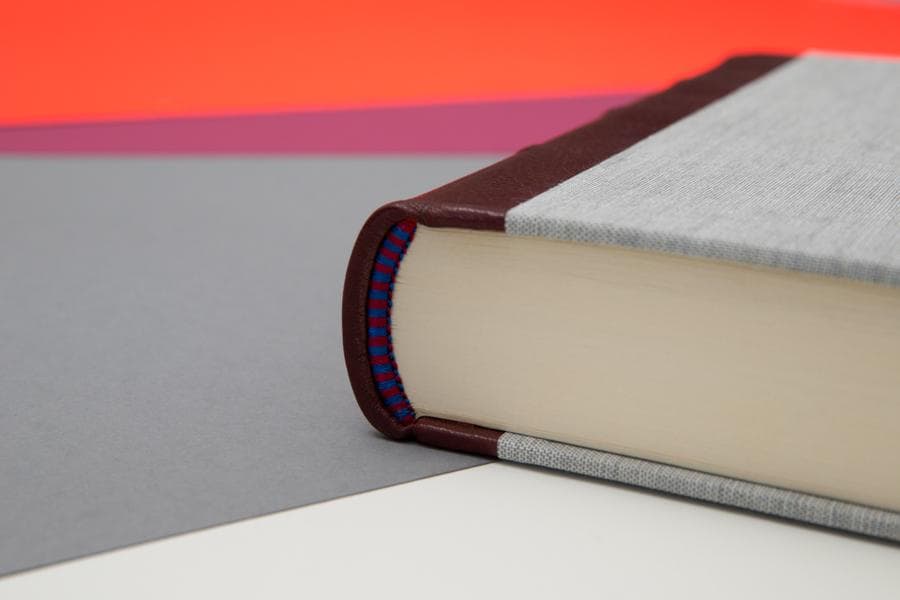
It is easy to own hundreds of books and never notice it
Take a hardcover book from a shelf and look down at the top of its spine.
Between the pages and the outer cover, you may see a tiny roll of colored thread. It might be red and white, blue and white, or simply a single dark color. Some books have another one at the bottom.
It is small enough to look like decoration added at the very end, which, on many modern books, is more or less what it is.
But the detail is much older than the modern hardcover.
That little strip is usually called a headband at the top of the book. The corresponding band at the bottom has traditionally been called a tailband. Book conservators often use the broader word endband for both.
And before it became mostly decorative, it had a job.
Old headbands were part of the book
A traditional book was not held together in quite the same way as a mass-produced hardcover today.
The folded groups of pages, called sections or gatherings, could be sewn together. Boards, cords, leather and thread formed a physical structure around them.
At the top and bottom of the spine, binders could sew an endband around a small core and attach it to the book itself.
The result was not merely a colored stripe sitting against the pages. It was connected to the binding.
The conservation reference Bookbinding and the Conservation of Books describes early headbands as an integral part of the book's sewing. They helped tie together the ends of the sections and strengthen a vulnerable part of the spine.
In other words, the pretty bit was once construction.
The top and bottom of a spine take a beating
The ends of a book's spine are awkward places.
They sit slightly exposed between the covers. The book flexes when it opens. It rubs against neighboring books. And, historically, readers were not always gentle when taking books from shelves.
William & Mary Libraries describes old headbands as reinforcement for the spine, particularly during removal from a shelf.
A properly worked headband could help spread some of that strain instead of leaving the edge of the spine covering to deal with it alone.
On surviving old bindings, conservators can sometimes see the threads running from the band down into the book. When the outer covering has worn away, the little decorative-looking object reveals that it was tied into a much larger structure.
It is one of those rare cases where a damaged old object can make its original engineering easier to understand.
Then the decoration started winning
Bookbinders did not leave the bands plain just because they were useful.
They worked them in colored threads, varied the patterns and turned a structural detail into a place for craftsmanship.
The Language of Bindings, a specialist terminology project for historic books, notes that the decorative role of endbands gradually became more important as their structural role declined, particularly from the 16th century onward.
That transition is easy to understand.
Once a part of a book is visible, people begin caring about how it looks. A binder could strengthen the spine and finish it beautifully at the same time.
Eventually, though, bookmaking changed enough that the two jobs no longer had to stay together.
Modern books often use the shortcut
Look closely at many modern hardcovers and the headband is no longer sewn through the book at all.
It is made separately — often as a long manufactured strip — cut to the width of the spine and glued into place.
The old bookbinding dictionary is unusually blunt about the difference: a headband that is integrated into the binding can reinforce the spine, while one that is only glued on is essentially decorative.
William & Mary Libraries makes the same distinction when comparing a 15th-century binding with modern books: old headbands were sewn into the structure; modern ones are commonly glued to the spine.
So the colored thread did not disappear when its original job became less important.
It became trim.
Why keep something that no longer has to be there?
Because books are not designed from scratch every generation.
They inherit a visual language.
Raised bands on a spine, decorative endpapers, cloth covers, ribbons, imitation leather and headbands can survive long after changes in manufacturing have altered or removed the practical reasons they first appeared.
A small headband makes the meeting point between the pages and the spine look finished. It hides a visually awkward edge. It can add a tiny bit of color to an otherwise plain binding.
More importantly, it looks like a hardcover book is supposed to look.
Once a useful construction detail becomes associated with quality and craftsmanship, it can survive as decoration even when the construction changes underneath it.
It is not always fake decoration
The modern glued-on version should not be mistaken for every headband made today.
Traditional and fine bookbinders still sew endbands by hand. Conservation work may reproduce or repair historical structures. Some contemporary bindings use endbands that are genuinely connected to the book rather than simply attached as trim.
There are also many historical variations. Endbands have been made with thread, leather, vellum and other materials, and the way they attach to the book has changed across periods and regions.
So there is no single construction hiding under every striped band.
The useful dividing line is simpler: some endbands are worked into the binding and do structural work; others are stuck on mainly for appearance.
Even the name is slightly messier than it looks
If you search for the part, you will encounter several names.
Headband traditionally refers to the band at the head, or top, of the spine. Tailband can refer to the one at the bottom.
In everyday modern bookbinding, however, 'headband' is often used loosely for both ends.
The term 'endband' gives the pair a convenient shared name and is widely used in the study and conservation of historic bindings.
Whatever name is used, it refers to the same tiny feature most readers can spend years seeing without ever thinking to ask about.
A modern hardcover can carry the ghost of an older book
That is what makes the little colored strip more interesting than it first appears.
On an old binding, the band could help hold together and reinforce one of the most vulnerable parts of the book.
On a mass-produced hardcover today, something that looks almost identical may simply be cut from a manufactured strip and glued on near the end of production.
The function faded. The shape stayed.
And now a tiny piece of colored thread can sit on a book made by modern machines while quietly imitating a piece of hand-bound construction that is centuries older.
It looks like decoration because today it often is.
It survived because once, it was part of what held the book together.