Why Does One Character Change SHA-256 Completely?
Change one character and a SHA-256 hash can look completely unrelated. Here is what happens inside the algorithm, from bytes and message blocks to 64 rounds of mathematical mixing.
Change one character. Watch the entire hash change.
Take a simple piece of text and calculate its SHA-256 hash. Then change just one character and calculate it again.
The two inputs can look almost identical to you. Their hashes do not.
That seems strange at first. If the input changed by one character, why does the output not change by one small part? Why does SHA-256 not produce something that looks like a slightly modified version of the original hash?
The answer is one of the most important ideas in cryptographic hashing: the avalanche effect.
But simply saying 'SHA-256 has an avalanche effect' does not really explain anything. The interesting question is what happens between the moment you change that character and the moment the final 256-bit digest appears.
To understand that, we have to follow your input through the algorithm.
SHA-256 is not random
The first thing to understand is that SHA-256 is completely deterministic.
Give it exactly the same input bytes twice and it produces exactly the same digest twice. There is no random number generator involved and no chance involved in choosing the result.
That makes the behavior more interesting, not less. SHA-256 is deterministic, but it is designed so that the relationship between a small change in the input and the final output becomes extremely difficult to recognize.
NIST describes SHA-256 as an iterative, one-way hash function that takes a message and produces a fixed-length message digest. Its standard specifically notes that a change to the message should, with very high probability, result in a different digest.
So when two nearly identical inputs produce completely different-looking hashes, the algorithm is not behaving randomly. It is behaving exactly as it was designed to behave.
A hash does not see characters. It sees bits.
There is another important detail hiding underneath the phrase 'one character change.' SHA-256 does not understand letters, words, emojis, spaces, or sentences in the way humans do. The hash function operates on bits.
For simple ASCII text, a character is represented by a byte. The lowercase letter a, for example, is represented by the byte 01100001. Change it to b and the byte becomes 01100010.
That means a human might describe the change as one character, while the hashing algorithm sees a change in the underlying bit sequence.
For Unicode text, the situation can be more complicated because the same visual concept can be represented by multiple bytes. This is why capitalization, whitespace, line endings, Unicode encoding, and visually similar text can all produce different hashes.
The practical rule is simple: SHA-256 hashes the exact bytes it receives. It does not know that two strings look almost identical to you.
What does 256-bit actually mean?
A SHA-256 digest contains 256 bits.
Because one hexadecimal digit represents four bits, those 256 bits are normally displayed as 64 hexadecimal characters.
That is why a SHA-256 result looks something like a long string of letters and numbers rather than resembling the original input.
The important property is that the input can be extremely long, while the output remains exactly 256 bits. NIST specifies SHA-256 with a 512-bit block size, 32-bit internal words, and a 256-bit message digest.
This fixed output size is part of what makes a cryptographic hash useful as a compact fingerprint of data.
The avalanche effect
Now we can define the phenomenon properly.
If you flip one bit of the input, a well-designed cryptographic hash should produce a large change in the output. For a 256-bit SHA-256 digest, the natural statistical target is roughly half of the output bits changing.
Half of 256 is 128.
That does not mean exactly 128 bits change every time. You might see 119 in one comparison, 131 in another, or 138 in another. The point is that the differences should be spread broadly across the output instead of remaining concentrated in one small region.
This broad spreading of differences is commonly called the avalanche effect or diffusion.
Research examining SHA-256's compression function has found that its average diffusion approaches the 50% region as the rounds progress.
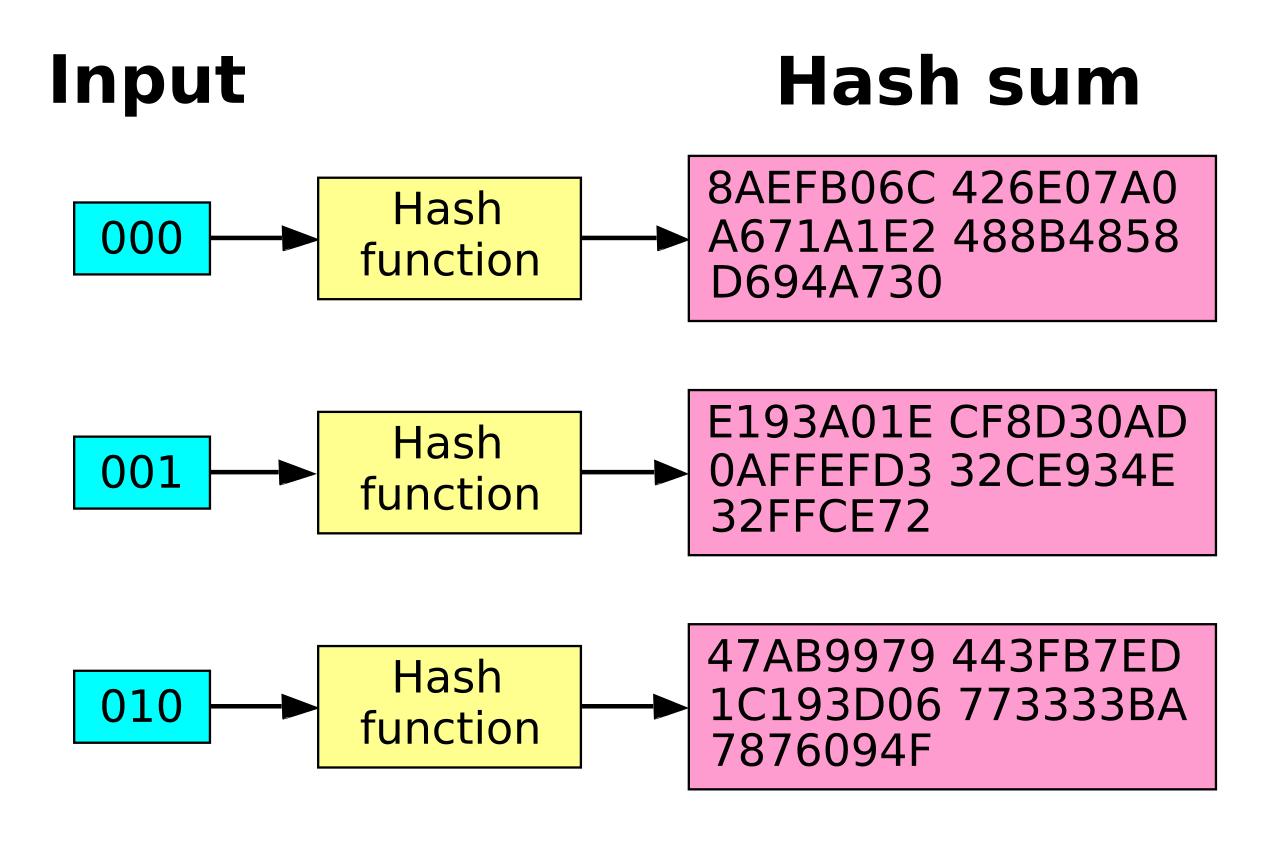
We tested the avalanche ourselves
To see whether this behavior is visible outside a textbook, we ran a large single-bit experiment.
We repeatedly took the same input, changed one input bit, calculated both SHA-256 digests, and counted how many of the 256 output bits were different. The number of changed bits is the Hamming distance between the two digests.
Across 100,000 one-bit changes, the average number of changed output bits was about 127.66 out of 256. That is 49.87% of the digest.
The median was 127 bits, with a standard deviation of about 8 bits. The observed values ranged from 102 changed bits to 148 changed bits.
That does not prove that SHA-256 is secure. An avalanche experiment cannot establish collision resistance or preimage resistance. What it does show is that the broad diffusion behavior is visible in a straightforward experiment: changing one input bit caused roughly half of the output bits to change on average.
Why is 128 the number we expect?
Imagine, as a simplified model, that every output bit has a 50% chance of changing when a particular input bit is flipped.
There are 256 output bits, so the expected number of changed bits is:
256 × 0.5 = 128.
The number of changed bits would approximately follow a binomial distribution with a mean of 128 and a standard deviation of 8 bits.
That is why a result such as 121 or 135 is not surprising. The algorithm is not trying to force exactly 128 bits to change. The important behavior is that the changes are broadly distributed around that statistical center.
This also explains why saying 'one bit changes every bit' is inaccurate. A good avalanche property does not mean every output bit flips every time. It means the output changes extensively and unpredictably enough that, statistically, each output position behaves close to the desired 50% target.
So how does one tiny difference spread?
This is where SHA-256 stops looking like a black box.
At a high level, SHA-256 takes your input through several stages:
The input is converted into a bit sequence → the message is padded → the padded message is divided into 512-bit blocks → each block is expanded into a message schedule → eight working values are initialized → the compression function performs 64 rounds of mixing → the resulting state becomes part of the final 256-bit digest.
Every stage gives the original difference more opportunities to interact with other information.
The important idea is that there is no single instruction called 'make the output completely different.' The avalanche emerges from many deterministic operations being applied repeatedly.
Step 1: SHA-256 pads the message
Before the main hash computation starts, SHA-256 preprocesses the message.
The message is padded so that it can be divided into the required block structure, and the original message length is incorporated into the padded representation.
NIST separates SHA-256 into preprocessing and hash computation. Preprocessing includes padding the message, parsing it into blocks, and setting the initial hash value.
That means the five letters in a short word do not simply enter the compression function as five bytes. They first become part of a carefully structured padded bit sequence.
If the input changes, the data being processed changes before the main rounds even begin.
Step 2: The message is split into 512-bit blocks
SHA-256 processes its padded input in 512-bit blocks.
Each 512-bit block can be viewed as sixteen 32-bit words. NIST specifies this exact structure for SHA-256.
For a short message, most of that first block is padding rather than human-readable text. For a longer message, the input can span multiple blocks.
The important part is what happens between blocks. SHA-256 carries an internal hash state from one block into the next. The result of processing an earlier block therefore influences how later blocks are processed.
This is one reason a small change near the beginning of a long message can eventually influence the final digest.
Step 3: Sixteen words become a 64-word message schedule
The first sixteen 32-bit words of a SHA-256 block are only the beginning.
The algorithm expands them into a sequence of 64 words, called the message schedule.
The additional words are derived from earlier words using bitwise functions, rotations, shifts, and addition modulo 2³². The exact recurrence is specified by the SHA-256 standard.
You can think of this as preparing a longer sequence of related material for the 64 compression rounds.
If one input bit changed in the original message, the values derived from that message are affected too. The original difference is therefore given more opportunities to enter the later rounds in different forms.
Step 4: SHA-256 maintains eight working values
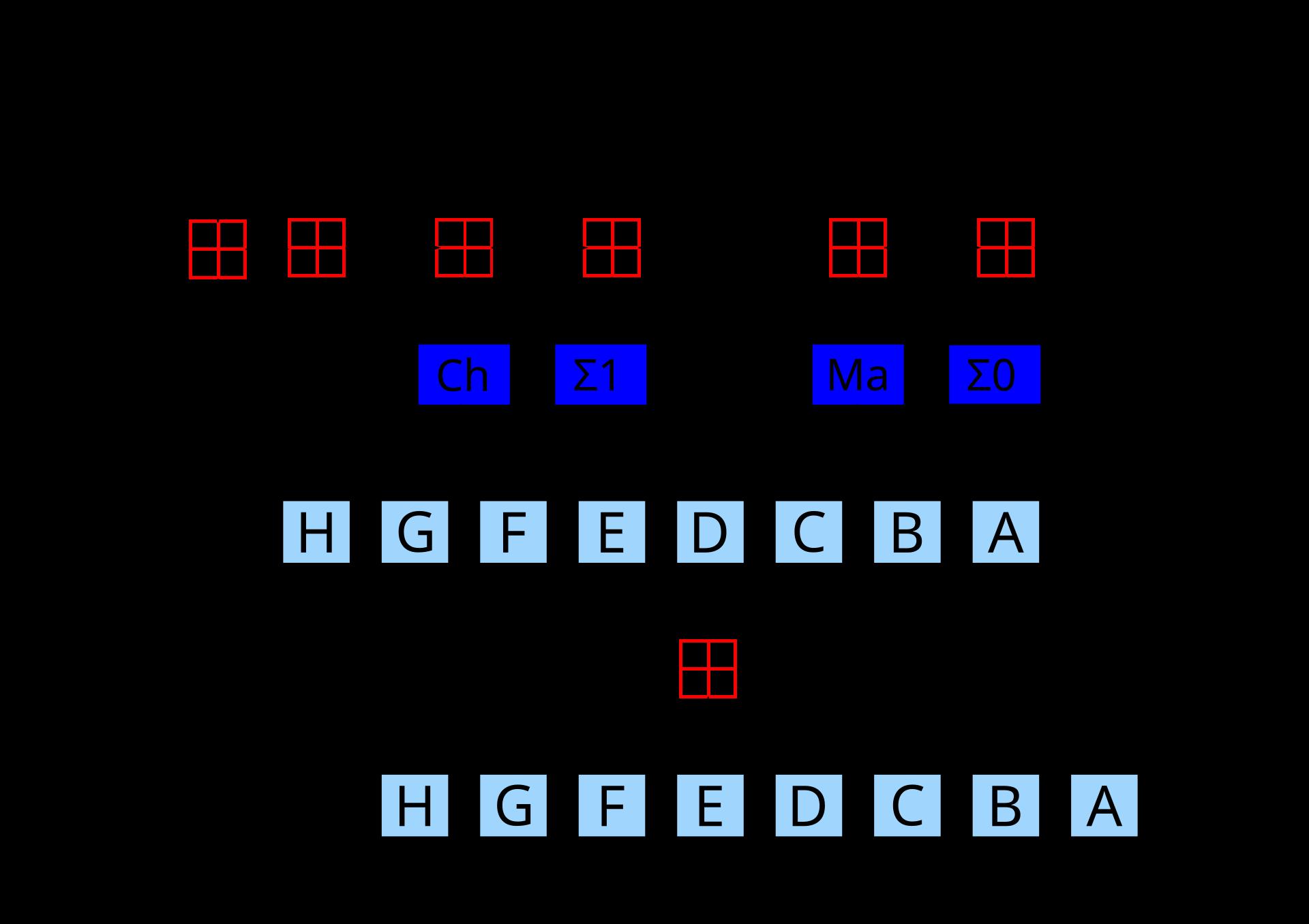
For SHA-256, the compression function works with eight 32-bit working variables, conventionally written as a, b, c, d, e, f, g, and h.
Eight 32-bit values contain 256 bits in total.
During each compression round, these values are transformed using the current state, one word from the message schedule, a round constant, and several logical and arithmetic functions.
The variables are then updated and used as the starting point for the next round.
This repeated state transformation is the heart of the diffusion process.
Step 5: Then come 64 rounds of mixing
Each SHA-256 block passes through 64 compression rounds.
The exact round operations combine the working variables with a scheduled message word and a round constant. The operations include Boolean functions, bit rotations, shifts, and addition modulo 2³².
The important thing is repetition. A difference that is tiny at the beginning is not mixed once. It is repeatedly fed into a changing internal state.
After one round, the difference has interacted with other values. After another round, those changed values become inputs to more operations. The process repeats again and again.
By the later rounds, the original difference has been spread through a large portion of the internal state.
XOR is part of the story, but it is not the whole story
SHA-256 uses XOR in several of its logical functions.
XOR operates independently at each bit position. Its basic rules are simple: 0 XOR 0 produces 0, 0 XOR 1 produces 1, 1 XOR 0 produces 1, and 1 XOR 1 produces 0.
But explaining SHA-256 as 'a bunch of XOR operations' would be seriously incomplete.
The algorithm also uses rotations, shifts, Boolean selection and majority functions, and modular addition. These operations interact with one another across many rounds.
The avalanche effect is therefore an emergent property of the complete construction rather than the result of one special operation.
Rotations move differences into new positions
A bit rotation moves the bits of a word around while preserving the number of bits in the word.
For example, rotating 10110001 to the right by two positions produces 01101100.
SHA-256 uses several rotation-based functions. Their job is not simply to make the numbers look different. Moving bits into new positions allows later operations to combine information that originated in different positions.
A difference that started in one bit position can therefore affect a different position during later calculations.
Addition introduces carries
One of the most useful ways to understand SHA-256's mixing is to look at addition.
Consider a tiny binary example:
01111111 + 00000001 = 10000000.
Changing one small part of an addition can create a chain of carries that changes several bits.
SHA-256 performs addition modulo 2³² on its 32-bit words. The carry behavior gives the algorithm a form of nonlinearity that simple XOR operations do not provide.
Research examining SHA-256's diffusion has found that carry behavior from integer addition, together with other internal functions, contributes substantially to diffusion in the compression process.
So when one bit changes, the algorithm is not merely moving that bit around. Arithmetic interactions can cause differences to spread into neighboring positions as well.
SHA-256 also uses CHOOSE and MAJORITY functions
Two named Boolean functions in SHA-256 are commonly written as Ch and Maj.
Ch, short for Choose, uses one bit pattern to select bits from two other values.
Maj, short for Majority, produces the bit value that occurs at least twice among three input values.
These functions give the compression process additional ways to combine its internal state. They are simple at the individual-bit level, but they become much more interesting when repeatedly applied to changing 32-bit words across dozens of rounds.
Even the rounds have their own constants
Each of SHA-256's 64 rounds uses a specific 32-bit constant.
The constants are fixed and are derived from the fractional parts of the cube roots of the first 64 prime numbers. The values are specified directly by the standard so implementations can reproduce the same algorithm.
These constants ensure that each round incorporates a defined value rather than simply repeating the exact same transformation without distinction.
Again, there is no randomness here. Everything is predetermined. The complexity comes from repeatedly combining predetermined operations and values.
Watch the avalanche develop
This is where the phrase 'avalanche effect' becomes much easier to understand.
Imagine changing one input bit and then examining the internal diffusion after successive rounds.
At the beginning, the difference is highly localized. After more rounds, it spreads through more of the internal state. Eventually, the average fraction of changed output positions approaches the familiar 50% region.
Research measuring SHA-256's diffusion across its 64 compression rounds has found that the mean approaches the 50% target as the rounds progress and becomes increasingly close to it toward the final rounds.
That gives us a much better mental picture of the avalanche. It is not an instantaneous transformation. It is the cumulative result of repeated mixing.
Avalanche effect does not mean every bit is perfectly random
There is an important technical distinction here.
The avalanche effect is the broad observation that changing a small part of the input produces a large, distributed change in the output.
A stricter statistical property is called the Strict Avalanche Criterion, or SAC. Roughly speaking, SAC asks whether each individual output bit changes with approximately 50% probability when a particular input bit is flipped.
Research has found that SHA-256 exhibits the broad avalanche effect while the behavior of individual input-output bit relationships is more nuanced than simply saying every output bit behaves like an independent fair coin.
That distinction matters. 'About half the bits change on average' is not the same statement as 'every output bit behaves like an independent fair coin.'
A completely different hash does not mean a unique hash
At this point, it is tempting to conclude that SHA-256 somehow gives every possible input its own unique fingerprint.
It cannot.
There are infinitely many possible inputs but only 2²⁵⁶ possible SHA-256 outputs. Eventually, different inputs must produce the same digest. These are called collisions.
The security goal is not to make collisions mathematically impossible. It is to make finding useful collisions computationally infeasible.
This distinction is fundamental to cryptographic hashing.
Avalanche, collision resistance, and preimage resistance are different ideas
The avalanche effect describes how changes spread through the output. It is not itself a complete definition of cryptographic security.
Collision resistance asks how difficult it is to find two different inputs with the same digest.
Preimage resistance asks how difficult it is, given a digest, to find an input that produces it.
Second-preimage resistance asks how difficult it is, given one particular input, to find a different input with the same digest.
NIST treats these as distinct security properties of cryptographic hash functions.
For an ideal 256-bit hash, generic collision searching has a birthday-bound complexity around 2¹²⁸, while generic preimage searching is around 2²⁵⁶. That is why a 256-bit hash is generally described as providing roughly 128-bit collision strength rather than 256-bit collision strength.
Why changing one character is useful for file verification
Now the strange behavior starts to make practical sense.
Suppose a software publisher gives you a file and publishes its expected SHA-256 digest.
You download the file and calculate its SHA-256 hash yourself.
If the calculated digest matches the published digest, the data you hashed produced the expected fingerprint. If even one byte of the file changed, the resulting digest will normally be dramatically different.
NIST specifically identifies message-integrity checking as a purpose of secure hash algorithms.
This is why SHA-256 is useful for verifying downloads, comparing files, checking backups, validating data transfers, and many other integrity-related tasks.
SHA-256 hashes bytes, not what your eyes see
This is one of the most practical lessons to take away.
These inputs look almost identical to a human:
hello
Hello
hello with a trailing space
hello followed by a newline
But they are different byte sequences.
SHA-256 does not decide whether those differences are meaningful. It simply processes the bytes it receives.
This is why two files that appear identical in a text editor can sometimes have different hashes. Hidden whitespace, line endings, metadata, encoding differences, or other byte-level changes can alter the input.
The hash is a fingerprint of the actual data, not a fingerprint of what a human thinks the data means.
This is also why text encoding matters
Consider a word containing a non-ASCII character or an emoji.
The visible character is not itself the thing SHA-256 processes. It must first be represented as bytes using an encoding such as UTF-8.
Change the encoding, change the underlying bytes, and you can change the hash.
This is one reason reproducible hashing requires agreement about the exact input representation. A hash function can be perfectly deterministic while two programs still produce different results because they fed different bytes into the algorithm.
SHA-256 is not encryption
Another common misunderstanding is to call a SHA-256 hash encrypted data.
Hashing and encryption solve different problems.
Encryption is designed around confidentiality and uses a key so that authorized parties can recover the original plaintext.
A cryptographic hash produces a fixed-size digest and is designed around properties such as integrity, collision resistance, and preimage resistance.
You do not decrypt a SHA-256 digest to recover the original file. The usual operation is to hash the candidate data again and compare the resulting digest.
And SHA-256 should not be treated as a password-storage algorithm by itself
A fast general-purpose cryptographic hash is useful for integrity checks, but password storage is a different problem.
Passwords are often low-entropy secrets that attackers can guess. A password-storage scheme therefore needs deliberate mechanisms such as salts and computationally expensive password hashing or key-derivation functions.
Simply running a password through SHA-256 once does not provide those protections.
The distinction is important because the same property that makes SHA-256 convenient for checking files, namely that it is fast to compute, can make it unsuitable as a standalone password-storage mechanism.
The bigger idea: deterministic algorithms can destroy visible relationships
We can now answer the original question.
Why does one character change SHA-256 completely?
Because SHA-256 is deliberately constructed so that small input differences are repeatedly transformed and diffused through its internal state.
The input becomes bits. The bits are padded into blocks. The blocks are expanded into message-schedule words. Those words are repeatedly combined with the internal state through Boolean functions, rotations, shifts, modular additions, and round constants. The resulting state feeds the next round, and the process continues for 64 rounds per block.
Nothing in that process is random.
But after enough deterministic mixing, the final 256-bit digest no longer preserves an obvious visual relationship to the original input.
That is the remarkable trick behind cryptographic hashing: deterministic computation can produce output that looks almost completely unrelated to small changes in the input.
The simplest way to remember it
Same bytes → same hash.
Tiny input change → large, distributed output change.
Different-looking hashes → not proof that collisions are impossible.
Hashing → not encryption.
And SHA-256 → a deterministic algorithm designed to make input relationships disappear through repeated diffusion.
Try changing one character yourself
The easiest way to make the avalanche effect click is to see it happen.
Enter a piece of text, calculate its SHA-256 hash, change one character, and calculate it again. Try adding a space. Remove a newline. Change capitalization. Replace one digit.
The inputs can remain visually similar while the 256-bit fingerprints become dramatically different.
You can calculate and compare SHA-256 hashes directly with the Olivez Hash Generator & Checker.
Sources
- 1.
- 2.
- 3.Hash Functions
NIST
- 4.
- 5.
- 6.Avalanche effect.svg
David Göthberg / Wikimedia Commons — Public domain
- 7.SHA256.svg
Enrique Santos / Wikimedia Commons — CC BY-SA 4.0