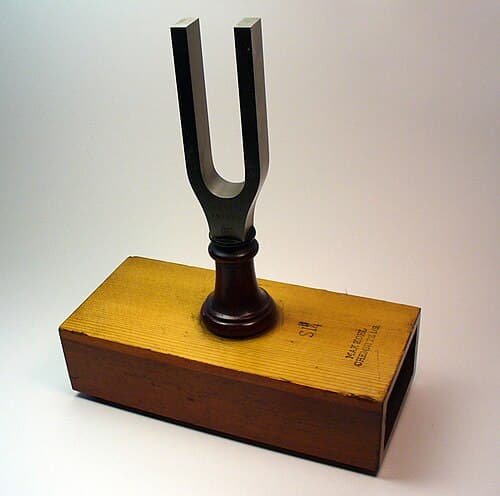
440 Hz feels more inevitable than it really is
Open almost any electronic tuner and it begins with the same assumption: A4 equals 440 Hz.
The number appears so consistently that it can seem like a property of music itself, as if the note A naturally vibrates 440 times per second.
It does not.
A note name describes a place within a musical system. Musicians still need a reference frequency to decide where that system sits in absolute pitch. Move the reference A from 440 Hz to 442 Hz and every other note moves with it while the relationships between the notes remain the same.
For much of musical history, different cities, orchestras and institutions used different reference pitches. The surprising part is not that the world eventually settled around 440 Hz. It is how long it took.
There was no universal concert pitch
Before modern standards, pitch could vary substantially from one place to another. Surviving tuning forks and historical instruments show that there was no single frequency everyone understood as the correct A.
An ISO history of musical pitch notes that a tuning fork made by John Shore in 1711 corresponds to about A = 423.5 Hz. Other historical pitch levels could be considerably higher or lower.
This created a practical problem. A musician traveling between cities could meet an orchestra tuned differently from the one at home. Singers could find familiar music sitting noticeably higher. Fixed pitch instruments such as organs could not simply be retuned in a few minutes.
By the nineteenth century, standardizing pitch had become more than a theoretical question.
Pitch had been creeping upward
During the nineteenth century, many orchestras and bands were playing at increasingly high pitch.
Contemporary accounts complained about the lack of uniformity and the strain high pitch placed on singers. An 1885 article in Nature described England using pitches around A = 452 Hz while France had already adopted a much lower standard.
Instrument makers were caught in the problem too. Wind instruments and organs built for one pitch could be difficult or expensive to adapt to another.
France eventually tried to stop the drift with a national standard.
France chose 435 Hz first
In 1859, the French government established the diapason normal, setting A at 435 Hz at a specified temperature.
It was one of the first serious national attempts to give musicians, institutions and instrument makers a common reference.
The idea spread. In 1885, an international conference in Vienna adopted A = 435 Hz among several European countries.
For a time, 435 looked like the number that might become the international answer.
That makes today's 440 Hz standard more interesting. The world did not move from chaos directly to 440. It first spent decades trying to organize itself around a different number.
The United States moved toward 440
Across the Atlantic, 440 Hz gained ground during the early twentieth century.
The American Federation of Musicians adopted A = 440 Hz as an official reference in 1917. It became widely known as American Standard Pitch.
The difference between 435 and 440 is small, roughly 20 cents, or about one fifth of a semitone. But a standard does not need a dramatic difference to cause incompatibility. Instruments, orchestras and manufacturers still have to agree on the same reference.
The American music industry was growing rapidly, and a shared pitch mattered increasingly for manufacturing, recording and performance.
1939 was an important turning point
In 1939, A = 440 Hz received international backing at a standards meeting organized through the international standardization system of the time and hosted by the British Standards Institution.
That decision is often described as the moment 440 became international concert pitch. It was important, but it was not the final step.
The International Organization for Standardization later adopted 440 Hz in its own work. ISO issued Recommendation R 16 in 1955, and the current formal standard became ISO 16:1975.
ISO 16 specifies that the A in the treble staff is 440 Hz and says musical instruments should be capable of being tuned to that reference.
So why exactly 440?
There is no convincing acoustic law that says 440 Hz is the one frequency A ought to have.
Earlier systems had worked at 435. Historical instruments had used many other references. Some proposals even tried to choose frequencies that produced mathematically convenient numbers elsewhere in the scale.
440 had practical advantages by the twentieth century. It was already established in parts of the musical world, especially in the United States. It was straightforward to generate and measure accurately with contemporary frequency standards. Most importantly, enough influential institutions were willing to use it.
Standards often become powerful for that reason. The value matters, but agreement on the value matters more.
440 Hz is a standard, not a command
Even today, not every orchestra performs at exactly 440 Hz.
Some orchestras use A = 442 Hz or another nearby reference. Historical performance groups may tune substantially lower to reproduce practices associated with earlier periods.
The difference between 440 and 442 is about 7.9 cents. Most listeners would not hear two performances several days apart and immediately identify that difference, but musicians playing together need to agree on it.
That is why many electronic instruments and tuners allow the reference pitch to be adjusted rather than permanently locking A4 to 440.
Changing A changes every note
| Reference | Difference from A440 | Context |
|---|---|---|
| A = 415 Hz | About 101 cents lower | Often used in Baroque performance practice |
| A = 435 Hz | About 20 cents lower | French diapason normal of 1859 |
| A = 440 Hz | Reference | ISO standard tuning frequency |
| A = 442 Hz | About 7.9 cents higher | Used by some modern orchestras |
Changing the reference does not alter the tuning pattern of an instrument. Standard guitar tuning is still E A D G B E. Each target frequency simply shifts with the new A4 reference.
Nobody discovered 440 Hz
A = 440 Hz was not uncovered in nature, and no single person simply invented modern concert pitch.
It emerged through decades of negotiation between musicians, governments, instrument makers, scientific laboratories, broadcasters and standards organizations.
France's 435 Hz standard brought order to part of the nineteenth century. The United States helped push 440 into wider use. Radio made the frequency easy to reproduce. International standards eventually gave it an official home.
The number on a tuner today is the end result of that history.